The shape of the lesson
By the end of the lesson, learners can
- state the principle of conservation of momentum and the condition for it to apply
- apply conservation of momentum to collisions and explosions in one dimension, using a sign convention
- distinguish elastic and inelastic collisions, and recall that for an elastic collision the relative speed of approach equals the relative speed of separation
- determine whether a collision is elastic by comparing the total kinetic energy before and after
- understand that momentum is conserved in a closed system whether or not kinetic energy is
Key vocabulary
closed system, conservation of momentum, elastic, inelastic, perfectly inelastic, explosion, relative speed of approach and separation. Each term is introduced as it is first needed.
Always momentum; only sometimes kinetic energy
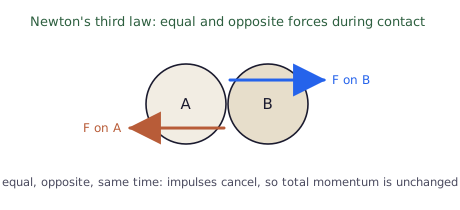
For a closed system with no external resultant force, the total momentum before an interaction equals the total momentum after. This follows from Newton's third law: during the interaction the two bodies exert equal and opposite forces for the same time, so they receive equal and opposite impulses, and the changes in momentum cancel. In one dimension, m₁u₁ + m₂u₂ = m₁v₁ + m₂v₂, with a chosen direction taken as positive.
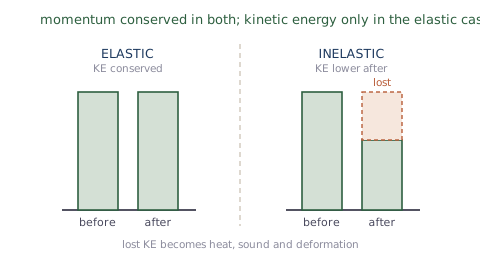
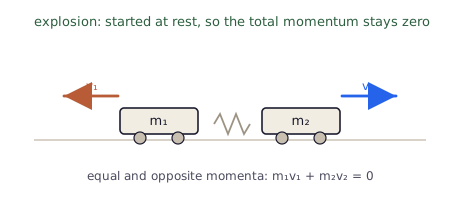
In an elastic collision the total kinetic energy is also conserved, and the relative speed of approach equals the relative speed of separation. In an inelastic collision momentum is still conserved but some kinetic energy is transferred to heat, sound and deformation; if the objects stick, it is perfectly inelastic. An explosion is the reverse: the parts start together at rest, so the total momentum is zero before and after, and the parts move apart with equal and opposite momenta.
Sixty minutes, phase by phase
| Time | Phase | What happens in the room | Resources |
|---|---|---|---|
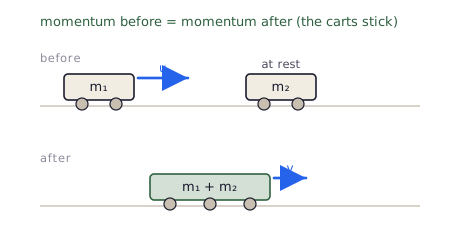
| 0 to 5 min | Starter | Show two trolleys colliding and sticking; ask what stays the same, drawing out momentum and energy. | Slide 1, fig-collision |
| 5 to 18 min | Teach: conservation | State conservation of momentum and link it to Newton's third law; model a sticking collision. | Slides 2 to 5, fig-newton-link |
| 18 to 30 min | Teach: elastic and explosions | Distinguish elastic and inelastic; model an explosion and a kinetic-energy check. | Slides 6 to 9, fig-explosion, fig-elastic-inelastic |
| 30 to 50 min | Activity | Run Connect-Extend-Challenge to consolidate the topic and surface the key question. | Connect-Extend-Challenge sheet |
| 50 to 60 min | Plenary | Address the most common Challenge (usually the energy question); exit ticket. | Exit ticket slide, fig-cec |
A sticking collision, an explosion, an elastic case
Example 1: inelastic (sticking)
A 2.0 kg trolley moving at 3.0 m s−1 hits a stationary 1.0 kg trolley and they stick. Find the common velocity and show the collision is inelastic.
Example 2: explosion
A 1.0 kg trolley and a 2.0 kg trolley are held together at rest and then spring apart. The 1.0 kg trolley moves off at 4.0 m s−1. Find the velocity of the 2.0 kg trolley.
Example 3: elastic, equal masses
A 0.50 kg ball moving at 4.0 m s−1 makes a head-on elastic collision with an identical stationary ball. Find the velocities afterward.
Connect-Extend-Challenge
This lesson closes the dynamics topic, so it is a good point to consolidate and surface the deep question of why momentum is conserved while kinetic energy may not be. After the teaching, each learner writes a Connect (how this links to what they already knew), an Extend (how it pushes their thinking further) and a Challenge (a question that still puzzles them), alone. Learners then share in groups, each group selects one Challenge for the class, and the teacher addresses the most common one. A full step-by-step facilitation guide, with the response sheet and teacher model responses, is provided as the activity in this bundle, so it can be run faithfully.
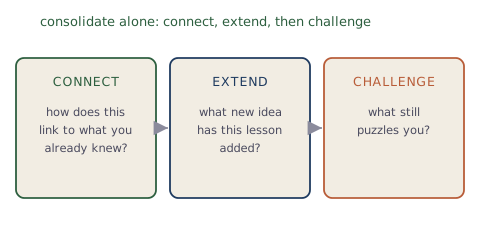
Why it suits this lesson. The routine consolidates a whole topic and makes the deep energy question visible. Each learner writes all three responses before sharing, which gives individual accountability, and the Challenges reveal who is still unsure.
What to head off, and how
| Trap learners fall into | Teaching move that pre-empts it |
|---|---|
| Believing kinetic energy is always conserved. | Only momentum is always conserved in a closed system; kinetic energy is conserved only in an elastic collision. |
| Ignoring direction in a collision. | Velocities in opposite directions must carry opposite signs; fix a positive direction first. |
| Thinking momentum is lost when objects stop after sticking. | The combined object still carries the total momentum; it just moves more slowly. |
| Assuming an explosion creates momentum. | The total momentum stays zero; the parts simply share equal and opposite momenta. |
Support, challenge and the checks
- Support: a before-and-after table (mass, velocity, momentum) to organise each problem before substituting.
- Challenge: use the relative-speed rule to solve an elastic collision of unequal masses, and explain where the lost energy goes in an inelastic case.
- Language: rehearse the frames "taking ... as positive, total p before = total p after" before learners write.
Assessment is formative. Exit ticket question 1: a 3.0 kg trolley at 4.0 m s−1 hits a stationary 2.0 kg trolley and they stick, find the common velocity. Exit ticket question 2: state which quantity is always conserved in a closed system and which is conserved only in an elastic collision. Each learner's three responses make their thinking, and any remaining question, visible.
Equipment and resources
- the Connect-Extend-Challenge response sheet, and the worksheet from this bundle
- a before-and-after table for support, and the exit ticket from the final slide
- the site simulation Conservation of Momentum, and the student topic page Conservation of momentum