The shape of the lesson
By the end of the lesson, learners can
- define the moment of a force as the force multiplied by the perpendicular distance from the pivot, and state its unit
- state and apply the principle of moments for a body in equilibrium
- define a couple and the torque of a couple
- solve problems on balanced beams, levers and couples, including a force applied at an angle
Key vocabulary
moment, pivot, perpendicular distance, line of action, principle of moments, clockwise and anticlockwise, couple, torque. Each term is introduced as it is first needed.
The moment, the principle, and the couple
The moment of a force about a point is the force multiplied by the perpendicular distance from the point to the line of action of the force, in N m. It is the turning effect of a force, so a force whose line of action passes through the pivot has no moment. The principle of moments says that for a body in equilibrium, the sum of the clockwise moments about any point equals the sum of the anticlockwise moments about that point.
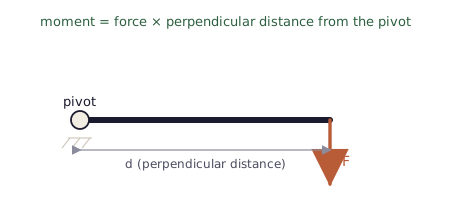
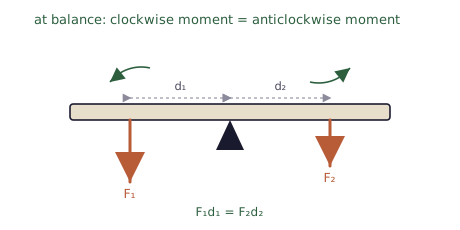
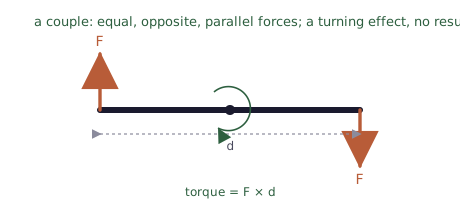
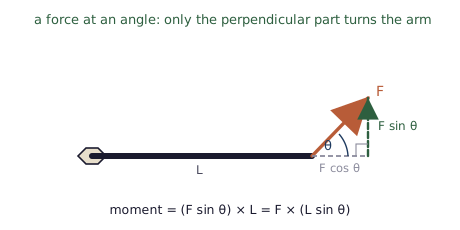
A couple is a pair of equal, opposite, parallel forces whose lines of action do not coincide; it produces a turning effect with no resultant force, and its torque is one of the forces multiplied by the perpendicular distance between them. When a force acts at an angle, use the perpendicular distance, which is the distance along the arm multiplied by the sine of the angle between the force and the arm.
Sixty minutes, phase by phase
| Time | Phase | What happens in the room | Resources |
|---|---|---|---|
| 0 to 5 min | Starter | Ask why a door handle is fitted far from the hinges; draw out the turning effect. | Slide 1, fig-moment |
| 5 to 18 min | Teach: moment and principle | Define the moment; model the principle of moments on a balanced beam. | Slides 2 to 6, fig-principle-moments, fig-seesaw |
| 18 to 27 min | Teach: couples and angles | Define a couple and the torque of a couple; show a force at an angle. | Slides 7 to 9, fig-couple, fig-angled-force |
| 27 to 50 min | Activity | Run Mix-Pair-Share over a set of balancing prompts of increasing difficulty. | Mix-Pair-Share prompt set |
| 50 to 60 min | Plenary | Review the hardest prompt; exit ticket. | Exit ticket slide |
A moment, a balance, a couple, an angle
Example 1: a moment
A force of 12 N acts at a perpendicular distance of 0.40 m from a pivot. Find the moment.
Example 2: the principle of moments
A uniform beam is pivoted at its centre. A 30 N weight hangs 0.80 m from the pivot on one side. How far from the pivot must a 40 N weight hang on the other side to balance it?
Example 3: a couple
Two parallel forces of 8.0 N act in opposite directions, 0.30 m apart, forming a couple. Find the torque.
Example 4: an angled force
A force of 10 N is applied at the end of a 0.50 m spanner, at 30 degrees to the spanner. Find the moment about the nut.
Mix-Pair-Share
Moments are best learned by talking through many short balancing problems with different partners. Learners mix around the room until a signal, then pair with the nearest person; the teacher poses a prompt, partners solve it and share their reasoning and answer, and learners then mix again for the next prompt with someone new. A full step-by-step facilitation guide, with the prompt set of increasing difficulty and teacher answers, is provided as the activity in this bundle, so it can be run faithfully.
Why it suits this lesson. At any moment half the class is explaining and half is listening, and partners change each round, so every learner rehearses the reasoning aloud repeatedly. That is exactly what fixes the perpendicular-distance idea and the choice of pivot.
What to head off, and how
| Trap learners fall into | Teaching move that pre-empts it |
|---|---|
| Using the distance along the arm instead of the perpendicular distance for an angled force. | Only the perpendicular distance counts; it is the distance along the arm times the sine of the angle. |
| Taking moments about the wrong point. | The principle holds about any point; choosing the pivot removes an unknown force from the equation. |
| Thinking a couple has a resultant force. | A couple has no resultant force, only a turning effect. |
| Confusing the unit of a moment (N m) with the joule. | Both are newton metres, but a moment is a turning effect, not energy. |
Support, challenge and the checks
- Support: a labelled beam diagram so learners mark each force, its distance and its turning sense before calculating.
- Challenge: solve a beam that is not pivoted at its centre, where the weight of the beam itself produces a moment about the pivot.
- Language: rehearse the frames "the perpendicular distance is ..." and "taking moments about ..., clockwise = anticlockwise" before learners write.
Assessment is formative. Exit ticket question 1: a 25 N force acts at a perpendicular distance of 0.30 m from a pivot, find the moment. Exit ticket question 2: a seesaw balances with a 250 N child 1.2 m from the pivot, how far from the pivot must a 300 N child sit on the other side? The changing-partner explanations make each learner's reasoning audible.
Equipment and resources
- the Mix-Pair-Share prompt set, and the worksheet from this bundle
- a labelled beam diagram for support, and the exit ticket from the final slide
- the site simulation The Turning Effect of a Force, and the student topic page Turning effects of forces