The shape of the lesson
By the end of the lesson, learners can
- state that the acceleration of free fall g near the Earth is approximately constant and about 9.8 m/s squared (often taken as 10)
- describe free fall as motion under gravity alone, with no air resistance
- explain that, with no air resistance, all masses fall with the same acceleration, so a hammer and a feather land together in a vacuum
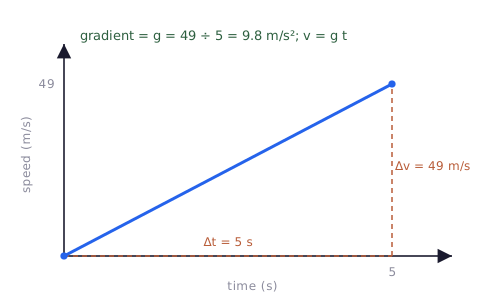
- recognise that the speed-time graph of free fall is a straight line whose gradient is g
- use v = g t to find the speed of a freely falling object
Key vocabulary
free fall, acceleration of free fall g, gravity, air resistance, vacuum, constant acceleration, speed-time graph. Each term is introduced as it is first needed.
One picture the whole unit shares
The unit shares one picture, the twin-graph poster, and this lesson adds its free-fall column. A freely falling object has a constant acceleration g, so its speed-time graph is a straight line whose gradient is g, and its speed after a time t is v = g t. The value of g near the Earth is about 9.8 m/s squared, often taken as 10. The simulation The Hammer and The Feather makes the key point visible: with the air removed, a hammer and a feather fall with the same g and land together, because the acceleration of free fall does not depend on mass.
Forty-five minutes, phase by phase
| Time | Phase | What happens in the room | Grouping |
|---|---|---|---|
| 0 to 5 min | Hook: drop them | The site simulation The Hammer and The Feather runs on the board. Learners predict, then watch a drop with air resistance on (the feather lags) and with it off (they land together). The question: what really decides how fast something falls? | Whole class, sim on board |
| 5 to 16 min | Build the idea | Free fall is defined as motion under gravity alone, with no air resistance. The acceleration of free fall g is about 9.8 m/s squared near the Earth, often taken as 10. With no air resistance every mass has the same g, so the speed-time line of free fall is straight, with gradient g, and v = g t. | Whole class, teacher led |
| 16 to 30 min | Numbered Heads Together | In teams of four, numbered 1 to 4, learners put their heads together on a short series of free-fall questions, making sure every member can answer, then a number is called to respond for the team. The full facilitation, with the question rounds, a teacher script and the answer key, is in the activity materials in this bundle. | Teams of four |
| 30 to 38 min | Check | On mini whiteboards, learners answer one v = g t calculation and state why a hammer and a feather land together in a vacuum. A number is called and that learner explains. | Individual, then whole class |
| 38 to 45 min | Plenary and exit | Exit ticket: state the value of g with its unit, explain in one line why mass does not change the acceleration of free fall, and find one speed with v = g t. Learners self assess against the objectives. | Individual |
Protect the parts that carry the learning
Numbered Heads runs in short rounds, so it flexes easily: add or drop a question to fit the time. Keep the build tight and protect the exit.
Protected: the exit ticket. It is the only individual check of the Core outcomes and is not cut.
If time is short: run three Numbered Heads rounds rather than five, keeping one recall, one explain and one calculation.
In a 60 minute block: time a small object falling a measured height and compare the calculated g with 9.8 m/s squared.
Numbered Heads Together, in brief
Learners sit in teams of four and number off 1 to 4. The teacher poses a question; the team puts their heads together and makes sure every member can answer; then a number is called and that member answers for the team. Because nobody knows in advance who will be called, every learner must be ready, which is the accountability the structure is built on. A full step-by-step facilitation guide, with the question rounds, sentence stems, a teacher script and the answer key, is provided as the activity in this bundle, so the structure can be run faithfully.
Why it suits this lesson. Free fall rests on a few precise ideas and one common misconception. Short, sharp Numbered Heads rounds let the class rehearse the correct statements and a v = g t calculation, while the random call keeps every learner accountable.
What to head off, and how
| Trap learners fall into | Teaching move that pre-empts it |
|---|---|
| Thinking heavier objects fall faster. | With no air resistance all masses fall with the same g. Mass does not change the acceleration of free fall. |
| Blaming gravity for the slow feather. | The feather is slow because of air resistance, not because g is different for it. Remove the air and it keeps pace. |
| Confusing g with weight or with a speed. | g is an acceleration, about 9.8 m/s squared. Weight is a force in newtons; speed is in m/s. |
| Drawing the free-fall line as a curve. | With no air resistance the acceleration is constant, so the speed-time line is straight, with gradient g. |
| Writing the unit of g as m/s. | The acceleration of free fall is about 9.8 m/s squared, not m/s. |
Support, challenge and the checks
- Support: a sentence frame for the key idea ("with no air resistance, all masses fall with the same g") and a worked v = g t example to copy from.
- Challenge: find the speed after a given time, then the time to reach a given speed, and sketch the matching free-fall speed-time line.
- Language: rehearse "the acceleration of free fall is about 9.8 metres per second squared" so the value and the unit are stated precisely.
Assessment is formative. Numbered Heads makes every learner ready to answer; the mini-whiteboard check with random call tests an individual; and the exit ticket maps to the Core outcomes, the value of g, the role of mass, and a v = g t calculation.
Equipment and resources
- mini whiteboards, and (for the optional practical) a small dense object, a measuring tape and a timer
- the Numbered Heads activity (with its facilitation guide), the worksheet and the exit ticket from this bundle
- the site simulation The Hammer and The Feather (Unit 1 simulations); the student topic page Free fall