Four numbers, one team, anyone may answer
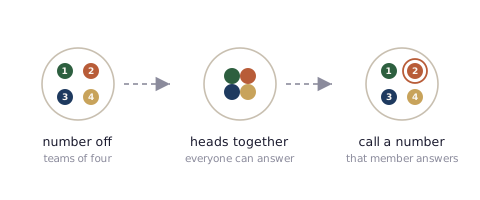
Numbered Heads Together is a four-step questioning structure. Learners sit in teams of four and each takes a number, 1 to 4. The teacher poses a question; the team puts their heads together so that every member can answer; then a number is called, and that member answers for the team.
It passes the PIES test:
The team is represented by whoever is called, so they help each other prepare.
Any member may be the one called.
Every member must be ready.
All teams discuss at once.
Three things to prepare
- Arrange teams of four and have a mini whiteboard for each team (or each learner).
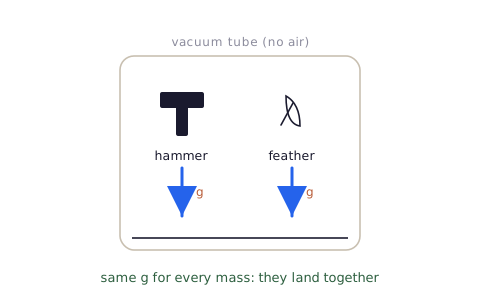
- Have the question rounds ready (below). The hammer-and-feather picture supports the concept round.
- If a team has three, one learner takes two numbers; if five, two learners share a number.
Setting up
Number off: each team assigns the numbers 1 to 4. Display or read one question at a time, so teams cannot run ahead.
About 12 to 14 minutes for five rounds
Teams assign the numbers 1 to 4.
Read or display the question and give a few seconds of silent thinking time.
The team discusses quietly and checks that every member, not only the strongest, can answer and explain.
Call a number 1 to 4; that member from one or several teams answers, on a whiteboard held up or aloud. Confirm, correct, and move on.
Using the whiteboards
For the calculation rounds, have the called member write the working and the answer on the team whiteboard and hold it up, so the whole class is checked at once and the working is visible.
Sentence stems for the heads-together phase
The teacher's role during the activity
Circulate during the heads-together phase and listen for the heavier-falls-faster misconception. Prompt teams to make sure the quietest member can answer, and vary which number you call across the rounds so that, over the activity, everyone is held accountable. Prompt rather than supply the answer.
Closing the activity
The random call is the accountability check: because anyone may be called, every learner prepares. Finish by restating the value of g with its unit and the relationship v = g t. This feeds straight into the exit ticket.
When the room does not behave like the plan
One member dominates: remind the team that any number may be called, so the quietest must be ready, then call that number.
A team is stuck: give a hint, not the answer, and return to them after the others.
Uneven teams: use the doubling rule (a learner takes two numbers, or two share one).
Calculation slips: ask for the working on the whiteboard so the error is visible and can be corrected.
- Support: keep to the recall and concept rounds, with the sentence frames provided.
- Challenge: add the time-to-reach-a-speed round (t = v ÷ g) and ask for a sketch of the matching free-fall graph.
Pose one round at a time
The hammer-and-feather picture supports Round 3.
What is the approximate value of the acceleration of free fall g near the Earth? Give the unit.
What is meant by free fall?
A hammer and a feather are dropped together inside a tube with the air removed. Which lands first, and why?
What does the speed-time graph of a freely falling object look like, and what does its gradient represent?
Taking g = 10 m/s², find the speed of a stone 4 s after it is dropped from rest.
Taking g = 10 m/s², a ball reaches a speed of 24 m/s as it falls. For how long has it been falling?
Confirm each answer before the next round
| Round | Answer |
|---|---|
| Round 1 | g is about 9.8 m/s² (10 m/s² is accepted). It is an acceleration. |
| Round 2 | motion under gravity alone, with no air resistance. |
| Round 3 | neither: they land together. With no air resistance both have the same acceleration g, which does not depend on mass. |
| Round 4 | a straight line from the origin. Its gradient is the acceleration of free fall, g. |
| Round 5 | v = g t = 10 × 4 = 40 m/s. |
| Round 6 (challenge) | t = v ÷ g = 24 ÷ 10 = 2.4 s. |