Think alone, justify in pairs, share with the class
Think-Pair-Share is a three-phase structure. Each learner first thinks alone and commits to an answer, then pairs up to compare and justify, then the class shares. Here the task is to match six described journeys to six distance-time graphs.
It passes the PIES test:
The pair must agree a justified match for every journey.
Each learner commits in the Think phase and may be called in the Share.
Both partners explain during the Pair phase.
Every pair is talking at once.
Three things to prepare
- Print one matching sheet per learner (the journeys and the graphs are below), or one set of cut-out cards per pair.
- Display the six graphs where all can see them, and have mini whiteboards ready for the Share.
- Decide pairs in advance. Mixed attainment works well, because justifying a match helps both partners.
About 14 minutes
Alone and in silence, each learner matches the six journeys to the six graphs and writes a one-word reason for each, for example horizontal, steeper, or curve. The silence matters: it makes every learner form an answer before any discussion.
Partners compare their matches. For any they disagree on, each explains their reasoning with the stems below, until they reach an agreed answer with a reason for every journey. The teacher circulates.
A random call (a name and a journey number) asks a learner to give the match and justify it. Take two or three, choosing the ones pairs found hardest.
Sentence stems for the Pair phase
The teacher's role during the activity
Circulate during the Pair phase and listen for the two key errors: reading a horizontal line as constant speed, and confusing a distance-time graph with a speed-time graph. Ask "how do you know?" rather than giving the answer, and note the disagreements you want to resolve in the Share.
Closing the activity
The random call in the Share is the accountability check: because anyone may be asked, every learner must be ready to justify a match, not just name it. Finish by restating the key readings: a horizontal line is stationary, a straight slope is constant speed, and a steeper line is faster. This feeds straight into the exit-ticket sketch.
When the room does not behave like the plan
A pair finishes early: ask them to write a short journey to fit any graph they did not use, or to redraw one journey as a speed-time graph.
A pair cannot agree: have them park that one and bring it to the Share for the class to settle.
One partner dominates: require each partner to explain at least three of the six matches.
A learner skips the Think phase: insist on a silent, individual commitment first; the Pair phase only works if both arrive with an answer.
- Support: reduce to four cards (stationary, constant speed, speeding up, there and back) and provide a word bank.
- Challenge: add a two-stage journey, or ask learners to redraw one journey as a speed-time graph, previewing Lesson 3.
Match each journey to one distance-time graph
Write a one-word reason for each.
A car is parked outside a house and does not move.
A person walks away from home at a steady pace.
A cyclist rides away at a steady but faster pace.
A train pulls out of a station, slowly at first, then faster and faster.
A runner sets off quickly, then gradually slows to a stop.
A child walks to the shop and comes straight back home.
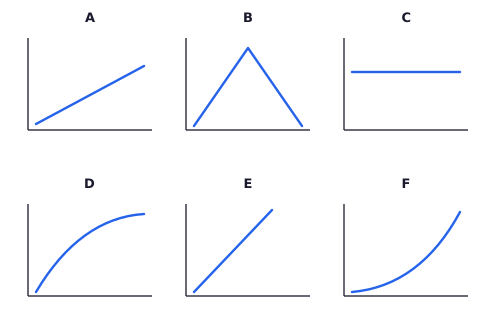
Matches, with the reason the graph fits
| Match | Why the graph fits the journey |
|---|---|
| J1 → C | a horizontal line: the distance is not changing, so the car is stationary. |
| J2 → A | a straight sloped line: a constant speed. |
| J3 → E | a straight line that is steeper than A: a faster constant speed. |
| J4 → F | a curve that gets steeper: the train is speeding up. |
| J5 → D | a curve that flattens: the runner is slowing to a stop. |
| J6 → B | the distance rises and then falls back to zero: out and back to the start. |