Measure, rotate, then reconcile
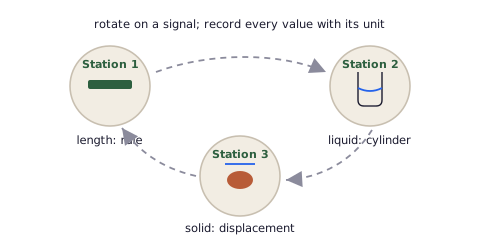
A measurement carousel sets up three stations around the room, each with its own instrument. Pairs work one station at a time, reading the instrument and recording every value with its unit on a single record sheet, then rotate to the next station on a signal. When the rotation is complete, each pair swaps sheets with another pair for the same items and reconciles any differences. Measuring is a skill learned by handling the instruments and comparing readings, not by watching.
It passes the PIES test:
Each pair keeps one shared record sheet, and the compare step needs another pair's readings to reconcile against.
Both partners record, and any learner may be called at random to report a station reading.
Partners alternate who reads the instrument and who records at each new station.
Every pair is measuring at the same time, each at a different station.
Three things to prepare
- Set up three stations, duplicated so no more than two or three pairs ever share one.
- Pre-fill the displacement (eureka) can to the spout before the lesson, and have a beaker or small cylinder ready to collect the water.
- Give each pair a single carousel record sheet (below) with a column for the value and a column for the unit.
About 25 minutes, in two phases
At the first station, decide who reads the instrument and who records. Swap the two roles at every new station so each partner does both.
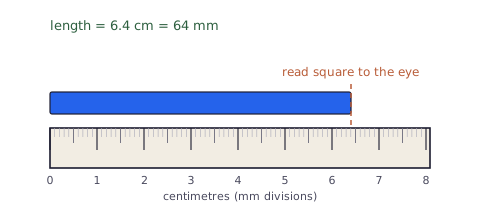
Read square to the scale, or at the bottom of the meniscus, and write the value with its unit in the record sheet. Note how you read it.
On a clear signal, move to the next station as a pair, leaving the apparatus as you found it for the pair behind you.
Swap your record sheet with another pair who measured the same items. Mark where your readings differ.
Explain each difference using the smallest division, parallax, and reading the bottom of the meniscus. Agree which reading is better and why; a small difference is not one pair being wrong.
Sentence frames for recording and comparing
The teacher's role during the activity
Keep the rotations crisp; transitions, not the measuring, are what overrun. Circulate and listen for the key habit, a value is a number and a unit, and watch the meniscus and displacement reads in particular. During the compare step, pick one or two differences to discuss with the whole class in terms of the smallest division and parallax.
When the room does not behave like the plan
A station bottlenecks: duplicate it so groups stay at two or three pairs, and keep each rotation to about six minutes.
The displacement can drips before the stone goes in: top it up to the spout and let it stop dripping before the first reading.
A pair gives a number with no unit: point to the unit column; the sheet is built so a value is not complete without it.
Readings differ a lot: that is the lesson; use the compare step to trace it to parallax or the wrong part of the meniscus.
- Support: a record sheet with the columns set out, pre-printed scales to annotate, and a units and prefixes reference strip.
- Challenge: add a station with a vernier or micrometer to compare the precision, and ask the pair to state a reading with its smallest division as a qualitative uncertainty.
Print one card per station
Read square to the scale and record every value with its unit.
Measure the length of the block, and the curved edge using string then the rule.
Read square to the scale, to the nearest millimetre. Record each value with its unit.
Measure the volume of liquid A and of liquid B.
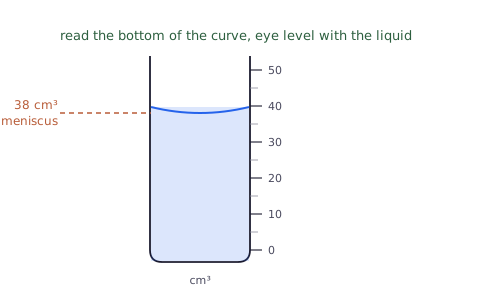
Read the bottom of the meniscus, with your eye level with the liquid. Record in cm³.
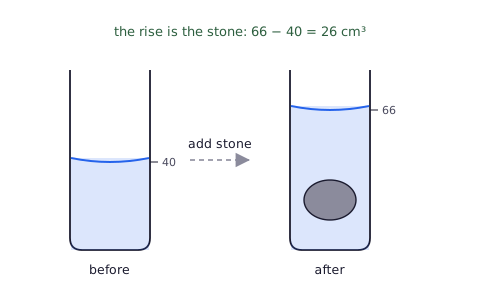
Read the water level, lower the stone in gently, then read the level again.
The volume of the stone is the rise: final reading minus first reading. Keep it fully submerged, with no trapped air.
A value is a number and a unit
Names: ________________________ Class: __________
| Measurement | Value | Unit | How I read it |
|---|---|---|---|
| Station 1: length of the block | cm or mm | ||
| Station 1: curved edge (string then rule) | cm | ||
| Station 2: volume of liquid A | cm³ | ||
| Station 2: volume of liquid B | cm³ | ||
| Station 3: water level before | cm³ | ||
| Station 3: water level after | cm³ | ||
| Station 3: volume of stone (after − before) | cm³ |
Compare and reconcile
Swap your sheet with another pair. Where do your readings differ, and why? Use the ideas of smallest division, parallax, and reading the bottom of the meniscus.
What a careful read looks like
The exact values depend on your apparatus, so there is no fixed answer key. These worked reads calibrate the method: a rule read square to the eye, a cylinder read at the bottom of the meniscus, and a stone found as the rise in level.