The shape of the lesson
By the end of the lesson, Core learners can
- choose a suitable instrument (a rule, a measuring cylinder or a displacement can) for a given length or volume
- read a scale at eye level and square to the scale, recording the value to the smallest division
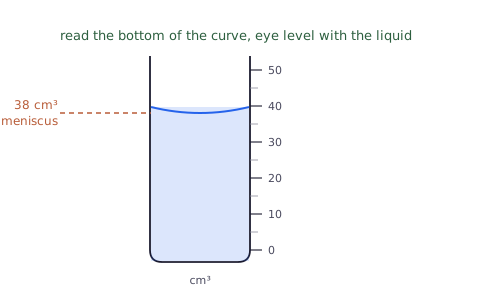
- measure the volume of a liquid with a measuring cylinder, reading the bottom of the meniscus
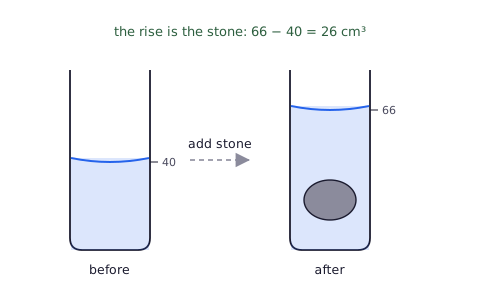
- measure the volume of an irregular solid by displacement
- record every measurement as a number with its unit (mm, cm, m and cm³)
Key vocabulary
physical quantity, unit, SI unit, smallest division, precision, meniscus, parallax, length, volume, displacement, irregular solid. Each term is introduced as it is first needed.
One bench, three instruments
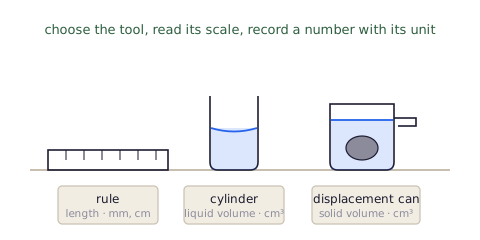
The lesson keeps returning to one picture: the lab bench. Each instrument is tagged with what it measures, its unit and its smallest division. The rule is read square to the eye to the nearest millimetre; the measuring cylinder is read at the bottom of the meniscus; the displacement can gives the volume of an irregular solid from the water it pushes out. Every reading is recorded as a number with its unit, and accuracy is shown to come from the smallest division and careful reading, not from the size of the instrument.
Forty-five minutes, phase by phase
| Time | Phase | What happens in the room | Grouping |
|---|---|---|---|
| 0 to 5 min | Hook: predict | A pencil is held against a rule and a beaker of water is shown. Learners answer two questions with a partner: exactly how long is the pencil, and exactly how much water is there. The point surfaces fast: a measurement is a number and a unit, and the answer depends on reading the scale carefully. | Think, Pair, Share |
| 5 to 15 min | Build the bench | The lab bench is modelled: how to choose the instrument and read each scale. The rule is read at eye level and square to the scale, to the nearest millimetre. The measuring cylinder is read at the bottom of the meniscus. The displacement can gives the volume of an irregular solid from the water it pushes out. The habit "value = number + unit" is fixed here. | Whole class, teacher led |
| 15 to 35 min | Main: measurement carousel | Three stations, with duplicate sets so no more than two or three pairs share one. Station 1: lengths of a regular block and a curved edge (rule and string). Station 2: the volume of a liquid (measuring cylinder, meniscus). Station 3: the volume of an irregular solid (displacement). Pairs rotate on a signal, recording each value with its unit on a carousel sheet. The full facilitation is in the activity materials in this bundle. | Pairs, carousel |
| 35 to 40 min | Compare readings | Pairs compare their carousel sheet with another pair for the same items and reconcile any differences. Small differences are explained by the smallest division and by how square the scale was read, not by one pair being wrong. | Pairs to fours |
| 40 to 45 min | Plenary and exit | Exit ticket: read three scales (a rule, a measuring cylinder and one more) and state each value with its unit. Learners self assess against the objectives. | Individual |
Keep the carousel moving
The carousel is the timing risk: rotations and transitions, not the measuring itself, are what overrun. Duplicate each station so groups stay small, and rotate on a clear signal.
Protected: the exit ticket. It is the only individual check of the Core outcomes and is not cut.
If time is short: run two stations (length and liquid volume) as the carousel and demonstrate the displacement can to the whole class instead of rotating through it.
In a 60 minute block: add a fourth station comparing a millimetre rule with a centimetre rule (and a vernier or micrometer), and a challenge to estimate the volume of an awkward solid.
A measurement carousel
Measuring is a skill that is learned by doing it and comparing, not by watching. Stations let every pair handle the instruments, and the compare step turns small differences in readings into a discussion about the smallest division and parallax. Because any learner may be called at random to report a station reading, both partners stay accountable. A full step-by-step facilitation guide, with the station cards, the carousel record sheet, the compare-and-reconcile step and the answer key, is provided as the activity in this bundle, so the carousel can be run faithfully.
Why it suits this lesson. Reading instruments well is a practical habit, best built by handling each one and then reconciling readings with another pair. The carousel gives every learner that hands-on turn, and the compare step makes the smallest division and parallax visible rather than abstract.
What to head off, and how
| Trap learners fall into | Teaching move that pre-empts it |
|---|---|
| Reading between the scale divisions, or from an angle (parallax). | Read at eye level and square to the scale, to the nearest division. Demonstrate how the value appears to shift when you move your head. |
| Assuming a bigger or longer instrument is automatically more accurate. | Accuracy comes from the smallest division and careful reading, not size. Compare a millimetre rule with a centimetre rule on the same object. |
| Reading the top of the meniscus, or not at eye level. | Read the bottom of the curved surface, with the eye level with the liquid. Model it once and keep a labelled picture on display. |
| Giving a number with no unit. | Build the habit "value = number + unit" and mark every answer against it from this first lesson. |
| In displacement, not submerging the solid fully, or subtracting the wrong way. | The solid must be fully under the water with no trapped air. The volume is the water collected, or the rise from the first reading to the second. |
Support, challenge and the checks
- Support: pre-printed scales to annotate, a units and prefixes reference strip, and a carousel sheet with the columns already set out.
- Challenge: measure the same object with a vernier or micrometer and compare the precision, estimate the volume of an awkward solid, and state a reading together with its smallest division as a qualitative uncertainty.
- Language: rehearse the frames "the length is ... because the smallest division is ..." and "the volume is ... cm³, read at the bottom of the meniscus" before learners write.
Assessment is formative. The exit ticket maps directly to the Core objectives, read three scales and state each value with its unit; random call after the carousel gives a quick read on individual understanding.
Equipment and resources
- a metre rule, a half-metre rule and a millimetre rule; string for curved lengths; one or two regular blocks
- measuring cylinders; a displacement (eureka) can with a collecting beaker or small cylinder; irregular solids such as stones
- a vernier or micrometer for the extension station; the carousel record sheet and the exit ticket from this bundle
- the site simulations The Multiple Measurement Method and Two Ways to Measure Volume; the student topic page Measuring length and volume