Choosing the instrument. Name the instrument you would use to measure each of the following.
Units and prefixes. Convert each measurement.
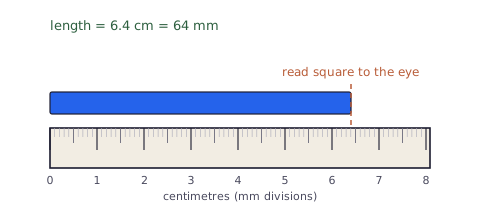
Reading a rule. The diagram shows a metal rod measured against a rule. State the length of the rod in (a) cm and (b) mm.
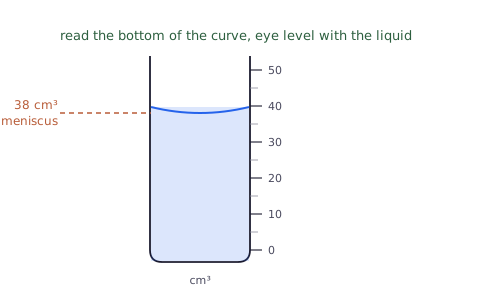
Reading a measuring cylinder. The diagram shows water in a measuring cylinder. State the volume of the water, and state where on the scale you read it.
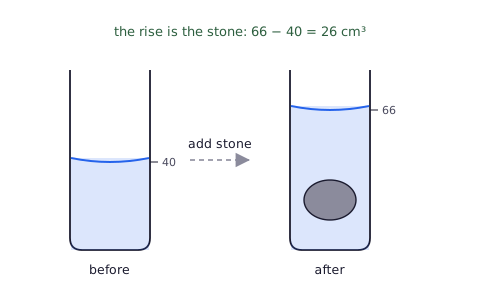
Volume by displacement. A stone is lowered into a measuring cylinder of water. The diagram shows the level before and after.
Accuracy. A learner says, "a longer ruler always measures more accurately." State whether this is correct and explain your answer using the idea of the smallest division.
Total: 15 marks. Original work by the TheLucidSTEM team. Written in the style of the papers; no past paper question is reproduced.
Answer key · full worked solutionsclick to reveal
(a) a measuring cylinder.
(b) a rule (ruler).
(c) a displacement (eureka) can, with a measuring cylinder to collect the water.
(a) 2.5 m = 2.5 × 100 = 250 cm.
(b) 45 mm = 45 ÷ 10 = 4.5 cm.
(c) 250 cm³ = 250 ÷ 1000 = 0.25 dm³.
(a) 6.4 cm. (b) 64 mm. Accept 6.3 to 6.5 cm, read square to the eye.
38 cm³ (accept 37 to 39 cm³). Read the bottom of the meniscus, with the eye level with the liquid.
(a) volume of stone = 66 − 40 = 26 cm³.
(b) so that the water it pushes aside equals the whole volume of the stone.
(c) any one: read at eye level / read the bottom of the meniscus / no trapped air bubbles on the stone.
Incorrect. Accuracy depends on the smallest division and careful reading, not the length of the ruler. A rule marked in millimetres is more precise than one marked only in centimetres, whatever their overall lengths.