The shape of the lesson
By the end of the lesson, Core learners can
- measure a time interval using a clock or a digital timer
- reduce random error by measuring multiples and dividing (the multiple-measurement method)
- find the period of a pendulum by timing many complete swings and dividing by the number of swings
- find the thickness of one sheet by measuring a stack and dividing by the number of sheets
- explain why timing many swings is more accurate than timing one
Key vocabulary
time interval, timer, stopwatch, oscillation, swing, period, reaction time, random error, average, multiple-measurement method. Each term is introduced as it is first needed.
Measure many, then divide
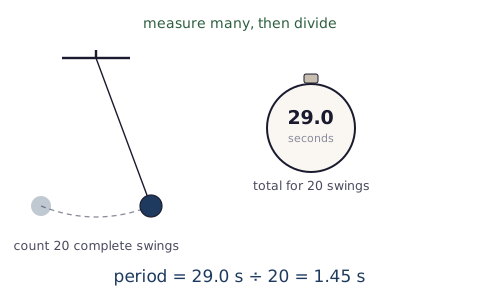
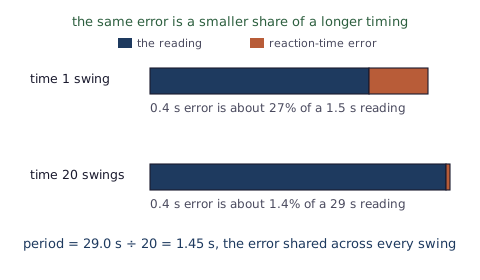
The lesson returns to one rule: measure many, then divide. A pendulum is timed over twenty complete swings and the total is divided by twenty to give the period; a stack of five hundred sheets is measured and divided by five hundred to give the thickness of one sheet. The reason is the heart of the lesson: the reaction-time error sits on the whole timing, roughly the same whether one swing or twenty is timed, so dividing the total by the number of swings shares that error out and shrinks it. Every reading is still recorded as a number with its unit.
Forty-five minutes, phase by phase
| Time | Phase | What happens in the room | Grouping |
|---|---|---|---|
| 0 to 5 min | Hook: predict | The teacher tries to time a single swing of a pendulum with a stopwatch. The value is clearly unreliable, because human reaction time is a large part of such a short reading. In pairs, learners suggest how to get a better value. | Think, Pair, Share |
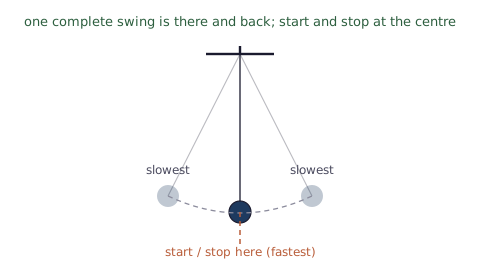
| 5 to 13 min | Build the method | The rule "measure many, then divide" is modelled. Time 20 complete swings, then divide by 20 to find the period. Measure a stack of 500 sheets, then divide by 500 to find one sheet. The reason is made explicit: the reaction-time error sits on the whole timing, so dividing by the count shares it out and shrinks it. Best practice: start and stop as the bob passes the centre, counting complete swings from zero. | Whole class, teacher led |
| 13 to 22 min | Numbered Heads Together | Two or three quick rounds of "how would you measure this small quantity?" (the thickness of one sheet, the time for one drip from a tap, the diameter of one bead). Groups agree one method and the division, then a number is called so any member can explain. The full facilitation is in the activity materials in this bundle. | Groups of four |
| 22 to 38 min | Practical: time the pendulum | In pairs, learners time 20 complete swings, repeat the timing, and divide to find the period. They compare their two values and note how repeating reduces the random error. Pendulums are set up before the lesson. A quick paper-stack measurement follows if time allows. | Pairs |
| 38 to 45 min | Plenary and exit | Exit ticket: given the total time for 20 swings, find the period, and explain in one sentence why timing 20 swings is better than timing one. Learners self assess against the objectives. | Individual |
Keep the discussion brisk
Two active blocks follow the build, so the discussion must stay brisk. Numbered Heads Together needs no equipment and should run in about nine minutes; the practical is where time slips, so set up the pendulums in advance.
Protected: the exit ticket. It is the only individual check of the Core outcomes and is not cut.
If time is short: run the pendulum as a teacher demonstration with the class counting the swings aloud, and keep Numbered Heads Together as the main cooperative task.
In a 60 minute block: run both the pendulum and the paper stack as genuine pairs measurements, add a third discussion round, and repeat the pendulum timing to show how repeats reduce random error.
Numbered Heads Together
Each learner in a group of four takes a number. The teacher poses a short question, "how would you measure this small quantity?" Learners first think alone, then put their heads together to agree one method and the calculation that goes with it. The teacher then calls a number, and that learner speaks for the group. Because nobody knows in advance who will be called, every member has to understand the agreed method, not just the most confident one. A full step-by-step facilitation guide, with the challenge cards and the pendulum results sheet, is provided as the activity in this bundle, so it can be run faithfully.
Why it suits this lesson. The content is a way of thinking, not a single fact, so it benefits from learners hearing several methods and judging which is sound. The structure forces that talk and keeps each learner accountable for it.
What to head off, and how
| Trap learners fall into | Teaching move that pre-empts it |
|---|---|
| Timing a single swing or a single short event. | Reaction time is a large share of one short reading. Time many and divide, so the same start-and-stop error is spread across the whole count. |
| Counting wrongly: starting the count at one, or timing a half swing. | Count complete swings, starting from zero as the bob passes the centre. One swing is there and back to the same point. |
| Starting and stopping at the end of the swing. | Start and stop as the bob passes the centre, where it moves fastest and is easiest to judge. Use a marker at the centre. |
| Forgetting to divide, or dividing by the wrong number. | Period = total time ÷ number of swings. One sheet = stack thickness ÷ number of sheets. Keep the unit on the answer. |
| Thinking a stopwatch with more decimal places is the real fix. | For hand timing the limit is human reaction time, not the display. Measuring many and dividing helps far more than extra decimal places. |
Support, challenge and the checks
- Support: a results table with the division already set out, a worked pendulum example, and a tally counter for the swings.
- Challenge: estimating the uncertainty from the spread of repeated timings, timing fifty swings and comparing, and a qualitative discussion of what the period depends on.
- Language: rehearse the frames "I would measure many ... and divide by ..." and "timing twenty swings is better because the reaction-time error is ..." before learners write.
Assessment is formative. The exit ticket maps to the Core objectives, a period found from a count and a one-sentence reason for measuring multiples; random call after Numbered Heads Together gives a quick read on individual understanding.
Equipment and resources
- a simple pendulum (string and bob) on a clamp stand, a stopwatch or digital timer, and a marker for the centre of the swing
- a thick stack of paper of known sheet count, and a rule to measure its height
- a results table and the exit ticket from this bundle; a longer count or a vernier for the extension
- the site simulation The Multiple Measurement Method, which applies the same method to length, volume and time; the student topic page Measuring length, volume and time