Think alone, agree together, anyone explains
In Numbered Heads Together, each learner in a group of four takes a number. The teacher poses a short question, "how would you measure this small quantity?" Learners first think alone, then put their heads together to agree one method and the calculation that goes with it. The teacher then calls a number, and that learner speaks for the group. Because nobody knows in advance who will be called, every member has to understand the agreed method, not just the most confident one.
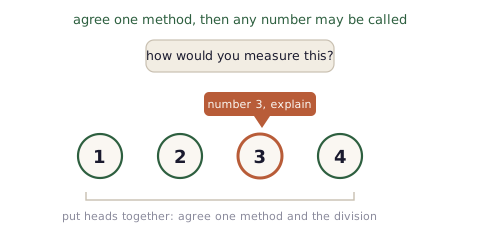
It passes the PIES test:
The group must agree one method together, because any member may have to explain it for the group.
A number is called at random, so each member is accountable for the agreed method and its calculation.
Every member numbers off and thinks alone first, so each has a view before the group agrees.
All groups discuss at once, so every learner is talking and thinking.
Three things to prepare
- Print the challenge cards (below), one set per group of four.
- Set up the pendulums in advance (string and bob on clamp stands), with a stopwatch and a centre marker for each pair.
- Print the pendulum results sheet for the practical that follows the discussion.
About nine minutes, two or three rounds
In each group of four, members take a number from 1 to 4.
Show one challenge card, "how would you measure this small quantity?" (the thickness of one sheet, the time for one drip, the diameter of one bead).
Each member thinks alone first, then the group puts heads together to agree one method and the division that goes with it.
Call a number from 1 to 4; that member explains the agreed method and calculation for the group. Repeat with the next challenge card.
Sentence frames for the answer
The teacher's role during the activity
Keep the rounds brisk; this is talk, not equipment. Circulate and listen for the key move, measure many and divide, and make sure every member, not just the loudest, can give the method. Choose a different number each round so accountability is real.
When the room does not behave like the plan
One member answers for everyone: remind the group that any number may be called, so all four must agree and understand.
A group gives a number with no method: ask for the measurement and the division, not just the answer.
An odd group of three: use numbers 1 to 3, or give one member two numbers.
It runs long: two rounds are enough; protect the pendulum practical and the exit ticket.
- Support: a results sheet with the division set out, and the sentence frame "measure many ... and divide by ...".
- Challenge: estimate the uncertainty from the spread of repeats, and time fifty swings to compare.
How would you measure this?
Print one set per group. The group agrees one method and the calculation; any number may be called to explain.
Calculation: ____________
Calculation: ____________
Calculation: ____________
Calculation: ____________
Measure many, then divide
Names: ________________________ Class: __________
Time the same number of complete swings each trial (for example 20). Start and stop as the bob passes the centre. Find the period for each trial, then take the best estimate.
| Trial | Number of swings | Total time (s) | Period = total ÷ number (s) |
|---|---|---|---|
| Trial 1 | |||
| Trial 2 | |||
| Trial 3 | |||
| Best estimate |
Explain
Why is timing 20 swings and dividing better than timing a single swing? Use the idea of reaction time.