The multiple-measurement method.
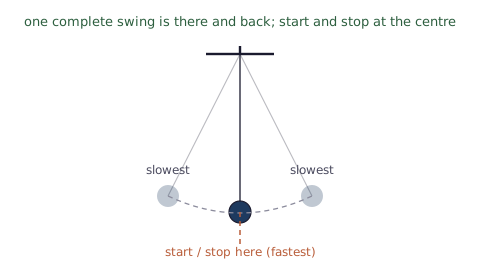
A pendulum is timed over 20 complete swings. The total time is 29.0 s. Calculate the period (the time for one swing).
A stack of 250 sheets of paper has a height of 25 mm. Calculate the thickness of one sheet, in mm.
A student times 10 complete swings four times and records: 14.8 s, 15.0 s, 14.9 s, 15.3 s.
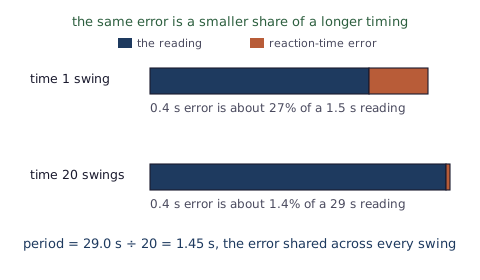
Explain why timing 20 swings and dividing by 20 gives a more accurate period than timing one swing. Refer to reaction time.
A tap drips steadily. A student wants the time for one drip.
Total: 15 marks. Original work by the TheLucidSTEM team. Written in the style of the papers; no past paper question is reproduced.
Answer key · full worked solutionsclick to reveal
(a) the time for one swing is short, and human reaction time (about 0.2 s) is a large fraction of it, so a single reading is unreliable.
(b) time a number of complete swings, for example 20, then divide the total time by the number of swings to find the period.
T = total ÷ number of swings = 29.0 ÷ 20 = 1.45 s.
thickness of one sheet = 25 ÷ 250 = 0.10 mm.
(a) average total = (14.8 + 15.0 + 14.9 + 15.3) ÷ 4 = 60.0 ÷ 4 = 15.0 s.
(b) period = 15.0 ÷ 10 = 1.5 s.
(c) a counting or timing slip, or a slow start or stop (reaction time). It is an anomalous result.
the reaction-time error happens once on starting and once on stopping, so it is about the same size whether one swing or twenty is timed. Dividing the total by 20 divides that error by 20 as well, so each swing's share of the error is much smaller.
(a) count a number of drips over a measured time with a stopwatch, then divide the total time by the number of drips.
(b) time for one drip = 48 ÷ 30 = 1.6 s.