The shape of the lesson
By the end of the lesson, Extended learners can
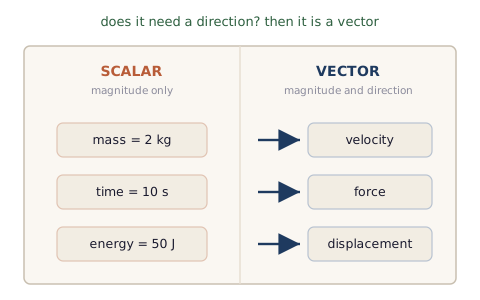
- define a scalar as a quantity with magnitude only, and a vector as a quantity with magnitude and direction
- classify common quantities: scalars such as distance, speed, time, mass and energy; vectors such as displacement, velocity, acceleration, force, weight and momentum
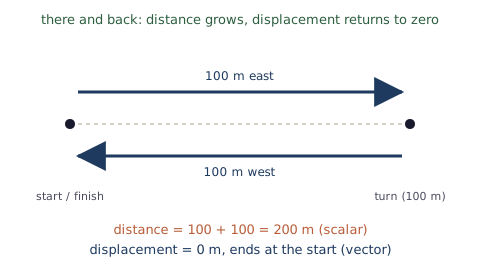
- explain the difference between distance and displacement, and between speed and velocity, using a journey
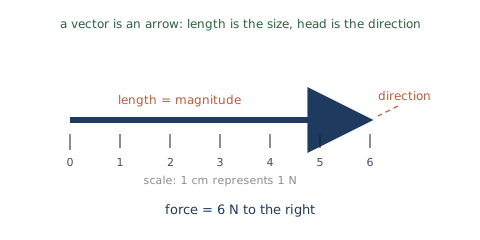
- represent a vector as an arrow whose length shows its magnitude and whose head shows its direction
Key vocabulary
scalar, vector, magnitude, direction, distance, displacement, speed, velocity, acceleration, force, weight, momentum, resultant (previewed for the next lesson). Each term is introduced as it is first needed.
One question of every quantity
The lesson is built on one picture: the arrow board. A vector is drawn as an arrow, its length the size and its head the direction; a scalar is written as a plain number with a unit. The site simulation The Round Trip Trap feeds straight into it: on a journey out and back, distance and average speed keep growing while displacement and average velocity carry a direction and can return to zero. That contrast is the whole lesson, so every quantity is tested with one question, does it need a direction?
Forty-five minutes, phase by phase
| Time | Phase | What happens in the room | Grouping |
|---|---|---|---|
| 0 to 5 min | Hook: the round trip | The site simulation The Round Trip Trap is run on the board. As a journey goes out and back, distance and average speed keep climbing, but displacement and average velocity point in a direction and can fall back to zero. The question lands: which of these quantities need a direction, and which do not? | Whole class, sim on board |
| 5 to 15 min | Build the arrow board | Scalar (magnitude only) and vector (magnitude and direction) are defined. A vector is drawn as an arrow whose length shows its size and whose head shows its direction; a scalar is written as a plain number with a unit. The key quantities are placed on the board, and the pairs that trip learners up are drawn out: speed and velocity, distance and displacement, and weight, which is a force and therefore a vector, against mass, which is a scalar. | Whole class, teacher led |
| 15 to 28 min | Quiz-Quiz-Trade | Each learner holds a quantity card. They find a partner, quiz each other ("scalar or vector, and why?"), coach if needed, then trade cards and find a new partner. The cards mix the core quantities with a few that provoke discussion. The full facilitation is in the activity materials in this bundle. | Pairs, moving |
| 28 to 38 min | Sort and justify | In fours, learners sort eight quantity cards onto a scalar and vector mat, then a number is called and that learner justifies one placement. This is the checkpoint: eight quantities sorted and defended. | Groups of four |
| 38 to 45 min | Plenary and exit | Exit ticket: classify a short list of quantities, and explain in one sentence why velocity is a vector but speed is a scalar. Learners self assess against the objectives. | Individual |
Keep the cards moving
Two card-based blocks follow the build. Quiz-Quiz-Trade must keep moving: give a clear signal to trade, and cap it so the sort and the exit are not squeezed.
Protected: the exit ticket. It is the only individual check of the Extended outcomes and is not cut.
If time is short: replace the sort with a quick mini-whiteboard vote (scalar or vector) on six quantities, and keep Quiz-Quiz-Trade as the main cooperative task.
In a 60 minute block: add a short Jigsaw, with expert pairs on scalars and on vectors teaching each other, and a preview of combining two vectors ready for Lesson 4.
Quiz-Quiz-Trade, then a sort
Each learner holds one quantity card. They pair up; learner A quizzes learner B, "scalar or vector, and why?", praises or coaches the answer, and then the roles swap. The pair then trade cards and split off to find new partners. Because the cards keep moving, every learner meets many quantities and has to give a reason each time, not just a label. A sort in fours, with random call, then acts as the group checkpoint. A full step-by-step facilitation guide, with the quantity cards, the sort mat and the answer key, is provided as the activity in this bundle, so both structures can be run faithfully.
Why it suits this lesson. Classifying is quick to say but easy to get wrong, so learners need many short, low-stakes attempts with immediate correction from a peer. Quiz-Quiz-Trade gives exactly that, and the reasons spoken aloud are where the misconceptions surface.
What to head off, and how
| Trap learners fall into | Teaching move that pre-empts it |
|---|---|
| Calling speed a vector, or velocity a scalar. | Speed is a scalar: how fast, only. Velocity is speed in a stated direction, so it is a vector. Use the round trip: speed stays positive, velocity changes direction. |
| Treating distance and displacement as the same. | Distance is the whole path travelled (a scalar). Displacement is the straight line from start to finish with a direction (a vector). A there-and-back journey has distance but zero displacement. |
| Thinking weight is a scalar like mass. | Weight is the force of gravity, so it is a vector and acts downwards. Mass, the amount of matter, is a scalar. |
| Giving a vector with no direction. | A vector answer needs a direction as well as a size, for example 5 N to the right, not just 5 N. |
| Confusing the size of a vector with a plus or minus sign only. | Magnitude is the size and is never negative. Direction can be shown by a sign along a line, by a bearing, or by an arrow. |
Support, challenge and the checks
- Support: a two column scalar and vector sorting mat for the cards, and the sentence frame "this is a ... because it has ...".
- Challenge: borderline cards to argue over (temperature, pressure and electric current are treated as scalars at this level), and an early look at combining two vectors into a resultant, ready for Lesson 4.
- Language: rehearse "a scalar has magnitude only; a vector has magnitude and a direction" and "velocity is a vector because it has a direction" before learners write.
Assessment is formative. Quiz-Quiz-Trade gives constant peer checking; the sort with random call tests whether learners can justify a classification, not just recall it; and the exit ticket maps to the Extended objectives.
Equipment and resources
- printed quantity cards for Quiz-Quiz-Trade and the sort, scalar and vector sorting mats, and mini whiteboards
- the site simulation The Round Trip Trap (Unit 1 simulations), shown on the board for the hook
- the quantity cards and sort mat from this bundle; the student topic page Scalars and vectors, for pre-reading or revision