Quiz a partner, then sort and defend
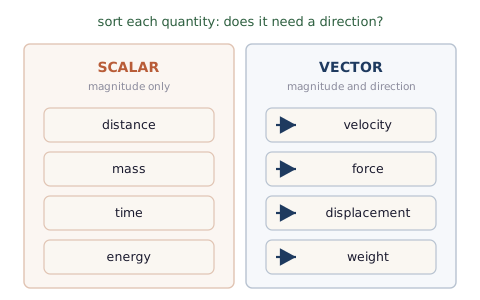
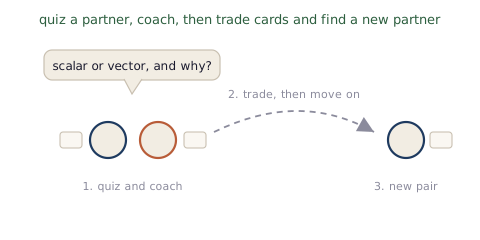
In Quiz-Quiz-Trade, every learner holds one quantity card. They find a partner, quiz each other ("scalar or vector, and why?"), coach the answer, then trade cards and find a new partner. Because the cards keep moving, each learner meets many quantities and must give a reason every time, not just a label. A sort in fours then acts as the checkpoint: eight cards are placed on a scalar and vector mat, and a called learner justifies one placement.
They pass the PIES test:
The quizzer is responsible for coaching the partner to the right answer, and the group sort needs every member's placements.
Each learner answers aloud with a reason on every trade, and any number may be called to justify a placement in the sort.
Partners swap quizzer and answerer, and the moving cards keep every learner meeting new quantities.
All pairs quiz at once, and then all fours sort at once.
Three things to prepare
- Print and cut the quantity cards (below), one per learner. For a large class, print a second set so there are enough to keep trading.
- Print a scalar and vector sort mat for each group of four.
- Have mini whiteboards ready, in case you switch to the quick vote if time is short.
About 23 minutes, in two phases
Give each learner one quantity card. They read it and check the small answer on the card so they can coach a partner.
Find a partner. Learner A asks "scalar or vector, and why?"; learner B answers with a reason; A praises or coaches. Then swap roles for the same pair.
The pair trade cards and split off to find new partners. Repeat on a clear signal so the room keeps moving.
In fours, place the eight sort cards onto the scalar and vector mat. Agree each one as a group, using the rule: does it need a direction?
Call a table and a number; that learner justifies one placement to the class. This is the checkpoint: eight quantities sorted and defended.
Sentence frames for the answer
The teacher's role during the activity
During Quiz-Quiz-Trade, circulate and insist on a reason, not just S or V; listen for the pairs that trip learners up: speed and velocity, distance and displacement, mass and weight. During the sort, read the placements and pick one or two borderline cards to discuss with the whole class.
When the room does not behave like the plan
A learner just gives the label: ask "and why?"; the reason is where the misconception shows.
A borderline card causes an argument (temperature, pressure, electric current): at this level treat them as scalars; that disagreement is good discussion, not a problem.
An odd number of learners: form one trio that rotates the quizzer each round.
The room stalls or gets loud: use a single clear signal to trade and move on.
- Support: the two column sort mat and the sentence frame "this is a ... because it has ...".
- Challenge: borderline cards to argue over, and an early look at combining two vectors into a resultant, ready for Lesson 4.
Print and cut, one per learner
The small letter is the answer for the holder to check against: S for scalar, V for vector.
Does it need a direction?
Place each card in the correct column. A scalar has magnitude only; a vector has magnitude and a direction. For the checkpoint, sort these eight: distance, velocity, mass, force, time, displacement, energy, weight.