Define each term.
Classify each quantity as a scalar (S) or a vector (V): distance, velocity, mass, force, time, displacement, energy, weight.
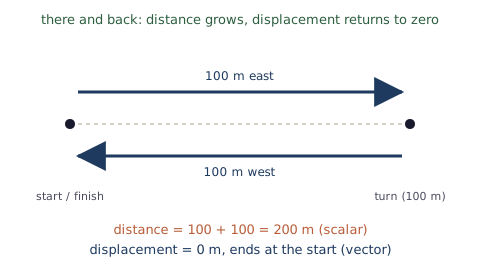
A runner travels 100 m due east, then returns 100 m due west to the starting point.
Explain the difference between speed and velocity. Include an example of each.
State whether each is a scalar or a vector, and give a reason: (a) mass, (b) weight.
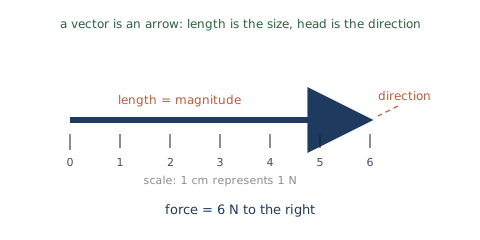
A force of 6 N acts to the right on a box.
Total: 15 marks. Original work by the TheLucidSTEM team. Written in the style of the papers; no past paper question is reproduced.
Answer key · full worked solutionsclick to reveal
(a) a scalar has magnitude (size) only.
(b) a vector has magnitude and a direction.
Scalars (S): distance, mass, time, energy.
Vectors (V): velocity, force, displacement, weight.
Marking: 1 mark per two correct, to a maximum of 4.
(a) total distance = 100 + 100 = 200 m.
(b) displacement = 0 m.
(c) displacement is the straight line from start to finish, with direction. The runner ends where they began, so the displacement is zero, even though the distance is 200 m.
Speed is how fast something moves, a scalar (for example 30 m/s). Velocity is speed in a stated direction, a vector (for example 30 m/s due north).
(a) mass is a scalar: it is the amount of matter, magnitude only.
(b) weight is a vector: it is the force of gravity and acts downwards, so it has a direction.
(a) force is a vector.
(b) draw an arrow pointing to the right; its length represents 6 N to a chosen scale (for example 1 cm to 1 N gives a 6 cm arrow).