Two stages, four experts, one whole picture
Jigsaw runs in two stages. In home groups of four, each member is assigned a different feature of a speed-time graph. The members then split into expert groups, where everyone with the same feature masters it together. They return to their home group and each teaches their feature, so the group assembles all four.
It passes the PIES test:
No home group has the whole picture unless every member teaches their part.
Each learner is the only expert on their feature and may be called at random.
Every learner both learns and teaches.
All the expert groups, and then all the home groups, work at once.
Three things to prepare
- Print the four expert cards (below) and one recording sheet per learner.
- Arrange home groups of four. If the numbers do not divide by four, double up a feature (two experts) rather than leaving one out.
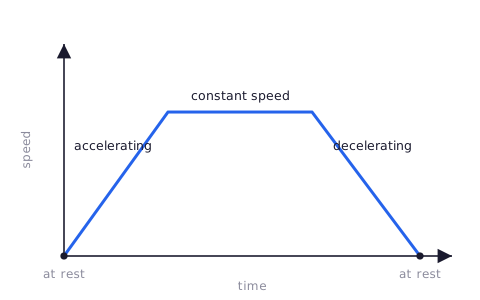
- Display the four feature graphs so every expert group can see them.
Setting up the groups
- Home groups: four learners, each given a different feature: 1 constant speed, 2 acceleration, 3 deceleration, 4 area under the line.
- Expert groups: all the 1s sit together, all the 2s together, and so on, to prepare their feature before returning home.
About 14 minutes
Number off 1 to 4 within each home group and hand out the matching expert card.
Learners with the same feature gather and agree what the line looks like, what it means, one example, and how they will teach it in about a minute.
Learners return to their home group; each expert teaches their feature in turn (about 90 seconds each) while the others fill in that row of the recording sheet.
The group reviews the full sheet; the teacher takes a random call, a name and a feature, to confirm everyone has all four.
Sentence stems for teaching back
The teacher's role during the activity
During the expert groups, visit each one and check the feature is correct before anyone teaches it, so no learner teaches an error. During the teach-back, listen for the graph-type confusion (a horizontal line is constant speed here, not stationary) and for the unit of acceleration, and prompt rather than correct. Take the random call at the end.
Closing the activity
The random call is the accountability check: because any learner may be asked about any feature, not just their own, everyone must learn all four. Finish by restating the four features and the unit of acceleration, m/s². This feeds straight into the exit ticket.
When the room does not behave like the plan
An expert is unsure: send them back to the expert-group notes or the displayed graph; never let an error be taught.
A home group is uneven: one member covers two features, or pair the area feature with a confident learner.
A group finishes early: ask them to sketch one journey that uses all four features in order.
Time runs short: drop the area feature to Lesson 5 and run three experts.
- Support: give the constant speed and acceleration features to those who need a firmer base, with the line shapes pre-drawn.
- Challenge (Extended): assign the area feature and ask for the distance from a triangle plus a rectangle, and treat a deceleration as a negative acceleration.
Cut out one card per expert
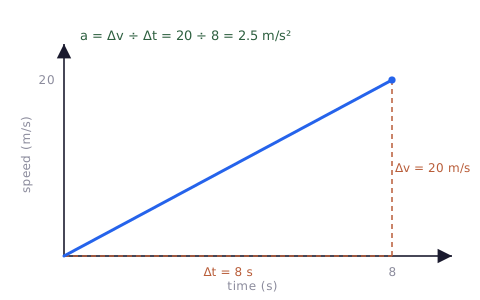
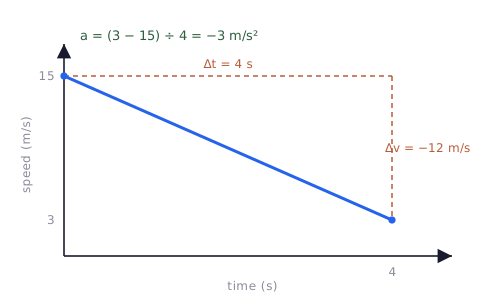
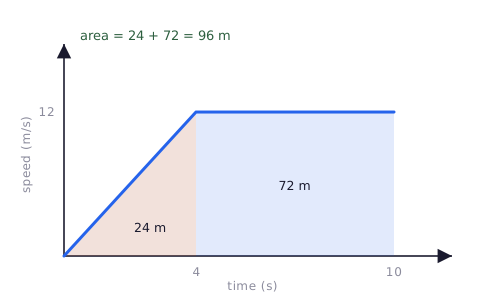
The feature graphs are shown on the cards for reference; the same figures are displayed in the slides.
Constant speed
- On a speed-time graph it looks like
- a horizontal line above the time axis.
- It means
- the speed is not changing: the object moves at a steady speed.
- Example or check
- a car holding 20 m/s on a motorway draws a flat line at 20 m/s.
Acceleration
- On a speed-time graph it looks like
- a line sloping upwards.
- It means
- the speed is increasing: the object is speeding up. a = Δv ÷ Δt, in m/s².
- Example or check
- from rest to 20 m/s in 8 s gives a = 20 ÷ 8 = 2.5 m/s².
Deceleration
- On a speed-time graph it looks like
- a line sloping downwards.
- It means
- the speed is decreasing: the object is slowing down. This is a negative acceleration (Extended).
- Example or check
- 15 m/s to 3 m/s in 4 s gives a = (3 − 15) ÷ 4 = −3 m/s².
Area under the line
- On a speed-time graph it looks like
- the region between the line and the time axis.
- It means
- the area under a speed-time graph is the distance travelled. Split it into a triangle and a rectangle and add them.
- Example or check
- a triangle of 0.5 × 4 × 12 = 24 m plus a rectangle of 6 × 12 = 72 m gives 96 m.
Fill in one row as each expert teaches
| Feature | What the line looks like | What it means (and an example) |
|---|---|---|
| Constant speed | ||
| Acceleration | ||
| Deceleration | ||
| Area under the line |
Teacher notes
- Constant speed: a horizontal line above the axis; the speed does not change.
- Acceleration: a line sloping up; the speed increases; a = Δv ÷ Δt in m/s².
- Deceleration: a line sloping down; the speed decreases; a negative acceleration (Extended).
- Area under the line: the distance travelled; split into a triangle and a rectangle (Extended).