The shape of the lesson
By the end of the lesson, Extended learners can
- describe how the speed of an object falling through a fluid changes as it falls
- explain, using forces, why a falling object accelerates at first and then reaches a constant velocity
- state that at terminal velocity the air resistance equals the weight, so the resultant force is zero and the acceleration is zero
- sketch and interpret the speed-time graph of an object that reaches terminal velocity
- explain what happens to the forces and the motion when a parachute opens
Key vocabulary
weight, air resistance (drag), fluid, resultant force, balanced forces, acceleration, terminal velocity, Newton's first law. Each term is introduced as it is first needed.
One picture the whole unit shares
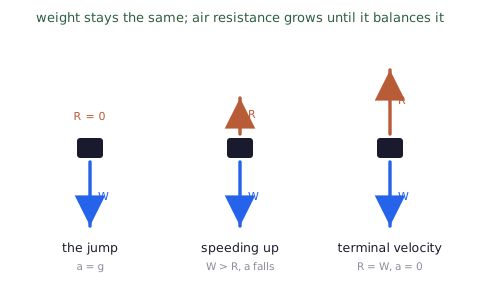
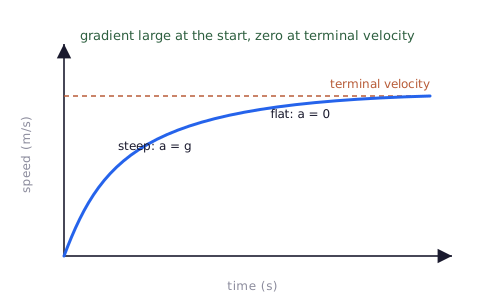
The unit shares one picture, the twin-graph poster, and this lesson builds its Extended force-balance column. Two forces act on a falling object: the weight acts downward and stays the same, while the air resistance acts upward and grows as the object speeds up. Just after the jump the air resistance is zero, so the resultant is the full weight and the acceleration is at its largest, g. As the speed rises the air resistance rises, the resultant (weight minus air resistance) falls, and the acceleration falls with it. When the air resistance has grown until it equals the weight, the resultant is zero: by Newton's first law there is no acceleration, and the object falls at a steady terminal velocity.
Forty-five minutes, phase by phase
| Time | Phase | What happens in the room | Grouping |
|---|---|---|---|
| 0 to 6 min | Predict: commit first | The Anticipation / Reaction Guide is handed out. Before any explanation, learners commit (agree or disagree) to six statements about a skydiver, alone and then in pairs. The simulation is named but not yet explained. | Individual then pairs |
| 6 to 12 min | Observe: run the sim | The Skydiver Force Balance runs on the board. Learners watch the weight and air-resistance arrows and the speed-time line as the skydiver speeds up and the line flattens. They note what actually happens. | Whole class, sim on board |
| 12 to 24 min | Explain: the forces | The force story is modelled: at the jump the air resistance is zero and a = g; as speed rises the air resistance rises and a falls; at terminal velocity the air resistance equals the weight, the resultant is zero, and a = 0. The matching speed-time graph is drawn. | Whole class, teacher led |
| 24 to 36 min | Reaction round | Pairs return to the six statements and complete the reaction column: agree or disagree now, each with a force reason. Then the parachute case is added: the air resistance jumps above the weight, so the skydiver slows to a new lower terminal velocity. | Pairs then fours |
| 36 to 45 min | Plenary and exit | Exit ticket: explain, using forces, why the skydiver reaches a terminal velocity, and sketch the speed-time graph. Learners self assess against the objectives. | Individual |
Protect the predict-then-observe order
The lesson is built on one cycle, predict then observe then explain, so protect the order: the prediction must come before the simulation, or the thinking is lost.
Protected: the exit ticket, the only individual check of the Extended outcomes, and the reaction reasons, where the physics is fixed.
If time is short: take the reaction round to four statements rather than six, and set the parachute case as the exit question.
In a 60 minute block: add a measured fall (a stack of paper cake cases dropped from a fixed height, timed) to show a real terminal velocity, then sketch its speed-time graph.
Predict-Observe-Explain, as an Anticipation / Reaction Guide
Learners first commit to six agree-or-disagree statements about a falling skydiver (the prediction), then watch the simulation (the observation), then return to the same statements and give a force reason for each (the explanation). Because every learner commits in writing before any teaching, each one has a stake in the answer, and the reaction round makes them confront any prediction that was wrong. A full step-by-step facilitation guide, with the statement sheet, the answers with reasons, sentence stems, a teacher script and the parachute extension, is provided as the activity in this bundle, so it can be run faithfully.
Why it suits this lesson. Terminal velocity is a topic where strong intuitions are often wrong: that heavier means faster forever, or that balanced forces mean stopped. Committing to a prediction first, then testing it, is what makes those intuitions visible and fixable, which is exactly Predict-Observe-Explain.
What to head off, and how
| Trap learners fall into | Teaching move that pre-empts it |
|---|---|
| Saying there are no forces at terminal velocity. | At terminal velocity the forces are balanced, not absent: the air resistance equals the weight, so the resultant is zero. |
| Confusing a zero resultant force with stopped. | Zero resultant means no acceleration, so a constant velocity. At terminal velocity the object is still moving, at its fastest steady speed. |
| Treating air resistance as constant. | Air resistance grows as the object speeds up; that is why the acceleration falls and the speed levels off. |
| Saying the weight changes as the object falls. | The weight (W = mg) stays the same; it is the air resistance that changes. |
| Saying a parachute stops the skydiver. | Opening the parachute makes the air resistance larger than the weight, so the skydiver slows to a new lower terminal velocity, not to a stop. |
Support, challenge and the checks
- Support: a part-completed force diagram for each stage (jump, speeding up, terminal) with the arrows to label, and the speed-time graph axes pre-drawn.
- Challenge: ask for the parachute case as a second speed-time graph, and for why a heavier skydiver has a higher terminal velocity.
- Language: rehearse "the resultant force is zero, so the acceleration is zero" and "balanced, not stopped" so the two ideas are never confused.
Assessment is formative. The prediction commits every learner before teaching; the reaction round makes them justify each answer with a force reason; and the exit ticket maps to the Extended outcomes, a force explanation and a speed-time sketch.
Equipment and resources
- the Anticipation / Reaction Guide (with its facilitation guide), the worksheet and the exit ticket from this bundle
- mini whiteboards for the reaction round, and graph paper for the speed-time sketch
- the site simulation The Skydiver Force Balance (Unit 1 simulation); the student topic pages Terminal velocity and Free fall