A skydiver falls through the air. State the two forces acting on the skydiver and the direction of each.
Just after jumping, the skydiver accelerates at about 9.8 m/s², but the acceleration soon becomes smaller. Explain why, using the forces.
Define terminal velocity in terms of the forces acting on the falling object.
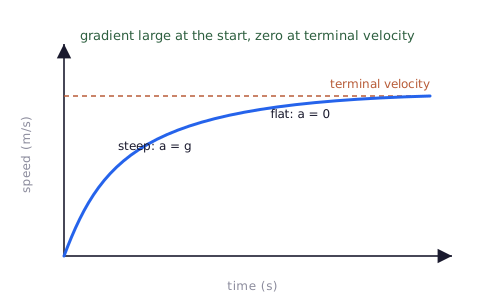
Sketch the speed-time graph for a skydiver from jumping until reaching terminal velocity. On your sketch, state what the gradient shows at the start and at terminal velocity.
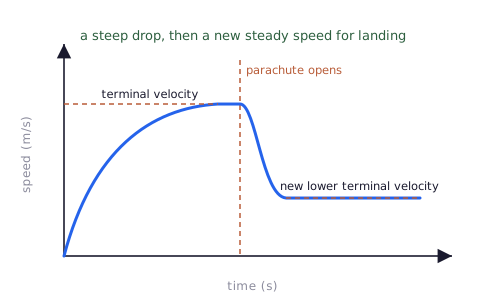
The skydiver then opens a parachute. Explain, using the forces, what happens to the motion immediately afterwards and what happens in the end.
A skydiver has a weight of 750 N. State the size of the air resistance acting on the skydiver at terminal velocity, and give a reason.
Total: 15 marks. Original work by the TheLucidSTEM team. Written in the style of the papers; no past paper question is reproduced.
Answer key · full worked solutionsclick to reveal
weight, acting downward; and air resistance (drag), acting upward.
Just after jumping the speed is low, so the air resistance is small (almost zero) and the resultant force is nearly the full weight, giving the largest acceleration, about g.
As the skydiver speeds up the air resistance grows, so the resultant force (weight minus air resistance) becomes smaller, and the acceleration becomes smaller with it.
the constant (maximum) velocity reached when the air resistance has grown until it equals the weight, so the resultant force is zero and there is no acceleration.
a curve that rises steeply from the origin, becomes less steep, and levels off to a horizontal line. at the start the gradient is large: a = g, the largest acceleration. at terminal velocity the gradient is zero: a = 0, a constant velocity.
the parachute greatly increases the air resistance, so it is now larger than the weight. the resultant force is upward, so the skydiver decelerates (slows down). as the speed falls the air resistance falls, until it again equals the weight; the skydiver then falls at a new, lower terminal velocity.
750 N. at terminal velocity the resultant force is zero, so the air resistance must equal the weight.