Teachers' Portal  /  The equations of motion  /  21st century skills activity
21st century skills activity · AS 9702 · 2.1

Equations of motion: running the Jigsaw

A step-by-step guide to running a Jigsaw on the four equations, with the four expert cards and the home-group quiz. The aim is that it can be run faithfully by any teacher, including a cover teacher.

Download editable (.docx) Back to the bundle
What it is, and why it works

Become an expert, then teach your group

Home groups of four split the four equations between them, one each. Experts on the same equation meet to master its derivation, its use and a worked example, and rehearse how to teach it. They then return home and teach their equation in turn, so every home group ends up with all four. An individual quiz closes the loop.
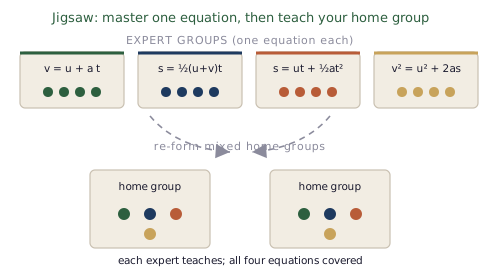
A Jigsaw: four expert groups each master one equation of motion, then re-form into mixed home groups where each equation is represented once and every expert teaches.
Master one equation, then teach your home group

It passes the PIES test:

Positive interdependence

A home group can only master all four equations if every expert delivers their part.

Individual accountability

The closing quiz covers all four equations, so each learner is accountable for the whole set.

Equal participation

Every learner is an expert on one equation and a teacher of it, so all have a turn.

Simultaneous interaction

Expert groups and then home groups all work at once, so the room is fully engaged.

Running the structure

About twenty-five minutes

Form home groups

Groups of four; within each, assign one equation (A, B, C, D) to each member.

Master in expert groups

Experts on the same equation meet to master its derivation, its use and a worked example, and rehearse teaching it.

Return and teach

Experts return to their home group and teach their equation in turn, so the group covers all four.

Individual quiz

Each learner takes the home-group quiz alone, covering all four equations.

Expert cards

One equation per expert

Print one set per home group; each member takes a different card.

Expert A
v = u + a t
Derivationon the v-t graph the acceleration is the gradient, a = (v − u)/t, which rearranges to v = u + a t.
Use it whenthe displacement s is not involved.
Master exampleu = 10, a = 2.0, t = 5.0 → v = 10 + 2.0 × 5.0 = 20 m s−1
Expert B
s = ½(u + v) t
Derivationthe displacement is the area under the line, a trapezium with parallel sides u and v and width t, so s = ½(u + v) t.
Use it whenthe acceleration a is not involved.
Master exampleu = 4.0, v = 10, t = 8.0 → s = ½(4.0 + 10) × 8.0 = 56 m
Expert C
s = u t + ½ a t²
Derivationsubstitute v = u + a t into s = ½(u + v) t to get s = ½(u + u + a t) t = u t + ½ a t².
Use it whenthe final velocity v is not involved.
Master exampleu = 0, a = 3.0, t = 5.0 → s = ½ × 3.0 × 5.0² = 37.5 m
Expert D
v² = u² + 2 a s
Derivationfrom v = u + a t write t = (v − u)/a, substitute into s = ½(u + v) t, and rearrange to v² = u² + 2 a s.
Use it whenthe time t is not involved.
Master exampleu = 2.0, a = 4.0, s = 4.0 → v² = 2.0² + 2 × 4.0 × 4.0 = 36, so v = 6.0 m s−1
Home-group quiz

Answer alone, all four equations

Each question is best solved with one of the four equations.

Q1
A train accelerates from 12 m s−1 at 0.50 m s−2 for 20 s. Find its final velocity.
Q2
A cyclist speeds up from 4.0 m s−1 to 10 m s−1 in 8.0 s. Find the distance travelled.
Q3
A car starts from rest and accelerates at 3.0 m s−2 for 5.0 s. Find the distance travelled.
Q4
A ball moving at 2.0 m s−1 accelerates uniformly over 4.0 m to reach 6.0 m s−1. Find the acceleration.
Teacher answer keyclick to reveal
Q1 (v = u + a t).

v = 12 + 0.50 × 20 = 22 m s−1.

Q2 (s = ½(u + v) t).

s = ½(4.0 + 10) × 8.0 = 56 m.

Q3 (s = u t + ½ a t²).

s = 0 + ½ × 3.0 × 5.0² = 37.5 m.

Q4 (v² = u² + 2 a s).

6.0² = 2.0² + 2 a × 4.0, so 36 = 4.0 + 8.0 a, giving a = 4.0 m s−2.

Troubleshooting and differentiation

When the room does not behave like the plan

A group is not a multiple of four: have one learner master two equations, or pair two learners on one card in the expert group.

An expert teaches the value but not the method: the expert card asks for the derivation and the use; insist on both before the quiz.

Expert groups finish at different times: give early finishers a second worked example to rehearse the teaching.

The quiz exposes a weak equation: note which one, and re-form that expert group briefly to reteach the home groups.

Original work by the TheLucidSTEM team. Designed for the lesson on this site; no past paper material is reproduced.
Back to the lesson bundle