The shape of the lesson
By the end of the lesson, learners can
- recall the four equations for uniformly accelerated motion
- derive each equation from a velocity-time graph
- state that the equations apply only when the acceleration is constant
- select the appropriate equation by identifying which quantity is missing
- apply the equations to straight-line motion, including deceleration and the sign convention
Key vocabulary
uniform acceleration, initial velocity u, final velocity v, displacement s, time t, suvat, gradient, area, sign convention, deceleration. Each term is introduced as it is first needed.
Four equations from one graph
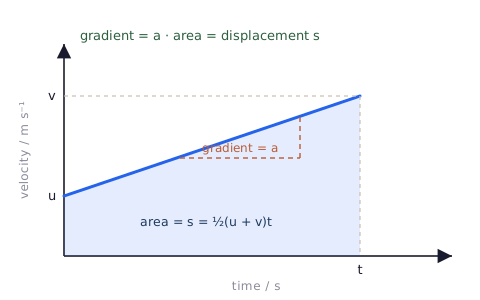
All four equations come from a single velocity-time graph for constant acceleration. The gradient gives v = u + a t; the area, a trapezium, gives s = ½(u + v)t; substituting one into the other gives s = u t + ½ a t²; and eliminating t gives v² = u² + 2 a s. The symbols are u, v, a, s and t.
Choose by the missing quantity
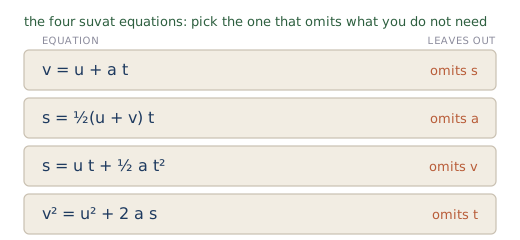
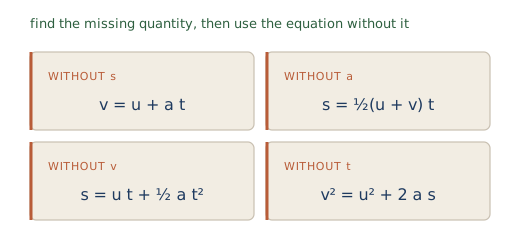
The fastest way to pick the right equation is to list u, v, a, s and t, then find the one quantity you neither know nor want: the equation that omits it is the one to use.
Where each one comes from
| Equation | Comes from | Omits |
|---|---|---|
| v = u + a t | gradient of the velocity-time graph, a = (v − u) / t | s |
| s = ½(u + v) t | area under the graph (a trapezium) | a |
| s = u t + ½ a t² | substituting v = u + a t into the area | v |
| v² = u² + 2 a s | eliminating t between the first and third | t |
Sixty minutes, phase by phase
| Time | Phase | What happens in the room | Resources |
|---|---|---|---|
| 0 to 5 min | Starter | Recall the gradient and area of a velocity-time graph from the last lesson. | Slide 1, fig-vt-derivation |
| 5 to 15 min | Teach | Introduce the symbols and show how the graph gives the first two equations. | Slides 2 to 4 |
| 15 to 40 min | Activity | Jigsaw: expert groups master one equation each, then return home to teach it, so every group covers all four. | Jigsaw expert cards and home-group quiz |
| 40 to 50 min | Model | Model selecting an equation by the missing quantity on a worked problem. | Slides 5 to 7, fig-equation-select |
| 50 to 60 min | Plenary | Individual quiz to close the Jigsaw loop; review the trickiest item. | Home-group quiz on the activity sheet |
Choosing, and handling signs
Example 1: choose by the missing quantity
A car accelerates uniformly from 8.0 m s−1 to 20 m s−1 over a distance of 60 m. Find the acceleration and the time taken.
Example 2: deceleration and signs
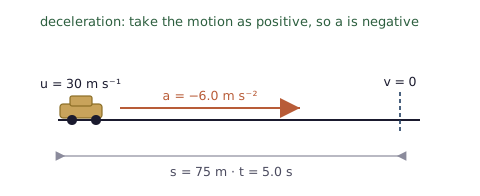
A car travelling at 30 m s−1 brakes at 6.0 m s−2. Find the stopping distance and the time to stop.
Jigsaw
Home groups of four split the four equations between them, one each. Experts on the same equation meet to master its derivation, its use and a worked example, and rehearse how to teach it; they then return home and teach their equation in turn, so every home group ends up with all four. An individual quiz closes the loop. A full step-by-step facilitation guide, with the four expert cards and the home-group quiz and answer key, is provided as the activity in this bundle, so it can be run faithfully.
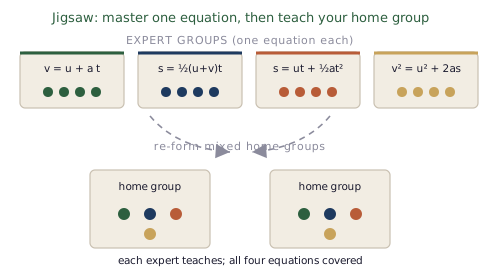
Why it suits this lesson. The four equations are a natural set of four specialisms. A home group can only master all four if every expert delivers their part, and the individual quiz makes each learner accountable for the whole set, not just their own equation.
What to head off, and how
| Trap learners fall into | Teaching move that pre-empts it |
|---|---|
| Using the equations when the acceleration is not constant. | They hold only for uniform acceleration. If the v-t line is not straight, the equations do not apply. |
| Mixing sign conventions. | Choose one positive direction and keep it for u, v, a and s throughout the whole problem. |
| Treating deceleration as a separate rule. | Deceleration is simply an acceleration opposite to the velocity, so it carries a negative sign. |
| Reaching for s = u t + ½ a t² every time. | List the knowns first; pick the equation that does not contain the quantity you neither know nor want. |
Support, challenge and the checks
- Support: a list-the-knowns frame (u, v, a, s, t) so learners spot the missing quantity before choosing an equation.
- Challenge: solve a two-stage journey (acceleration then constant velocity) and a problem where the object reverses direction.
- Language: rehearse the frames "the quantity I do not need is ..." and "so I use ..." before learners commit to an equation.
Assessment is formative. Exit ticket question 1: a train starts from rest and accelerates at 0.50 m s−2 for 20 s, find its final velocity and the distance travelled. Exit ticket question 2: state which equation you would use to find v when u, a and s are known, and explain why. The individual Jigsaw quiz covers all four equations.
Equipment and resources
- the Jigsaw expert cards and home-group quiz, and the worksheet from this bundle
- a list-the-knowns frame for support, and the exit ticket from the final slide
- the site simulation Free Fall and the Equations of Motion, and the student topic page Equations of motion