One solves aloud, one coaches, then switch
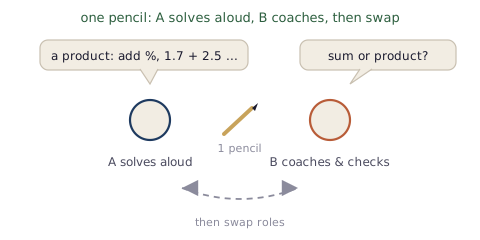
Pairs share one problem set. For each problem, one partner is the solver and the other is the coach. The solver thinks aloud and writes the solution; the coach watches, praises correct steps, and questions any step that looks wrong. They switch roles for the next problem, so both learners solve and both coach. Because the solver must reason out loud and justify each step, neither partner can stay passive.
It passes the PIES test:
One pencil and one solution per problem, so the pair must work as solver and coach together.
The solver reasons aloud and justifies each step, and the roles alternate, so both have to solve.
Solver and coach swap every problem, so the work and the talk are shared evenly.
Every pair is working at once, so a large share of the class is solving and coaching.
About twenty minutes, six problems
Pairs share one problem set and one pencil. Decide who solves first.
The solver works the problem out loud and writes it down. The coach watches, praises correct steps, and asks a question if a step looks wrong.
For the next problem the partners swap: the coach becomes the solver, and the solver coaches.
Alternate through the six problems. The teacher circulates and gathers common slips to review in the plenary.
Sentence frames for the coach
The teacher's role during the activity
Listen for the rule being chosen, not just the arithmetic: adding percentages for a sum, or forgetting that a power multiplies the percentage uncertainty. Note the slips that recur and surface them in the plenary so the whole class hears the correction.
Six problems, solver and coach alternate
Teacher answer keyclick to reveal
absolute uncertainty = half the smallest division = 0.5 mm = 0.05 cm; percentage = (0.05 / 24.5) × 100 = 0.2 percent.
z = 5.00 − 3.00 = 2.00 cm; Δz = 0.05 + 0.05 = 0.10 cm, so z = 2.00 ± 0.10 cm. The percentage uncertainty is 0.10 / 2.00 = 5 percent, much larger than in x or y, because subtracting close values keeps the absolute uncertainty but shrinks the result.
percentage uncertainties are (0.2 / 12.0) × 100 = 1.7 percent and (0.1 / 4.0) × 100 = 2.5 percent; total = 4.2 percent. R = 48, absolute uncertainty = 4.2 percent of 48 = 2, so R = 48 ± 2.
V = a3, so percentage uncertainty = 3 × (0.02 / 2.00) × 100 = 3 × 1 = 3 percent.
this is a random error (reaction time). Improve by timing many oscillations and dividing, by repeating and averaging, or by using light gates.
precise but not accurate. The tight grouping shows good precision; the uniform 5 percent offset shows a systematic error, so the readings are not accurate.
When the room does not behave like the plan
The coach just watches silently: remind them to praise a correct step and to ask a question, not give the answer, when a step looks wrong.
The solver works in silence: the rule is to think aloud; the coach can only help if they can hear the reasoning.
An odd number of learners: form one trio that rotates solver, coach and a second checker.
A pair races ahead: ask the coach to also state which rule was used and why, before moving on.
- Support: give the combining-rules card to the coach, and a part-worked example with the final step left for the solver.
- Challenge: add a problem that combines three quantities including a power, and ask for the final result to the correct number of significant figures.