The shape of the lesson
By the end of the lesson, learners can
- define linear momentum as p = m v and state its unit
- state Newton's second law as the resultant force equals the rate of change of momentum, F = Δp / Δt
- show that F = m a is a special case of this for constant mass
- define the impulse of a force and relate it to the change in momentum, impulse = F Δt = Δp
- recall that the area under a force-time graph is the impulse
- explain how increasing the time of an impact reduces the force, and apply this to safety features
Key vocabulary
linear momentum, vector, rate of change of momentum, impulse, force-time graph, contact time, safety feature. Each term is introduced as it is first needed.
Momentum, force and impulse
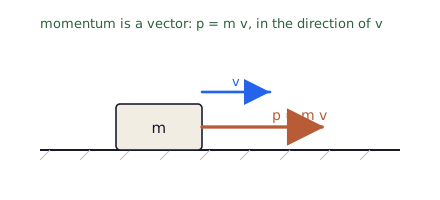
Linear momentum is p = m v, a vector in the direction of the velocity, with unit kg m s−1, so a sign or direction is always needed. Newton's second law in its general form is F = Δp / Δt: the resultant force equals the rate of change of momentum. For constant mass this becomes F = m (v − u) / t = m a, the familiar special case.
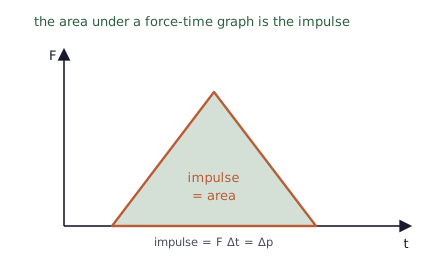
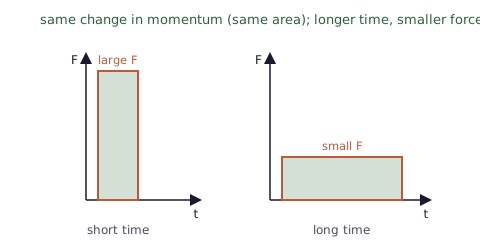
The impulse of a force is F Δt and equals the change in momentum, with unit N s (the same as kg m s−1). On a force-time graph, the impulse is the area under the graph. For a fixed change in momentum, a longer contact time gives a smaller force, which is exactly why crumple zones, airbags and bending the knees reduce the force felt.
Sixty minutes, phase by phase
| Time | Phase | What happens in the room | Resources |
|---|---|---|---|
| 0 to 5 min | Starter | Ask why a high jumper lands on a thick crash mat rather than the floor; introduce impact time. | Slide 1 |
| 5 to 20 min | Teach: momentum and force | Define momentum; state the second law in momentum form; show F = m a as a special case. | Slides 2 to 6, fig-momentum, fig-force-momentum |
| 20 to 28 min | Teach: impulse | Define impulse; show it as the area under a force-time graph. | Slides 7 to 9, fig-impulse-graph |
| 28 to 50 min | Activity | Run Round Table: groups generate situations where impact time changes the force, each adding one example in turn. | Round Table activity sheet |
| 50 to 60 min | Plenary | Sort the examples into reduce-the-force and increase-the-force; exit ticket. | Slide 10, fig-airbag |
Momentum, a rebound, and a safety feature
Example 1: momentum
A car of mass 1500 kg travels at 20 m s−1. Find its momentum.
Example 2: force from a rebound
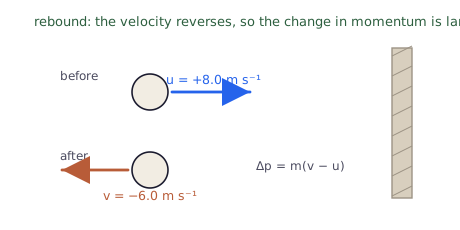
A 0.16 kg ball hits a wall at 8.0 m s−1 and rebounds at 6.0 m s−1. The contact lasts 0.020 s. Find the average force on the ball.
Example 3: impulse and safety
A 70 kg passenger moving at 14 m s−1 is brought to rest. Compare the force when stopped in 0.10 s with the force when an airbag extends this to 0.70 s.
Round Table on impact time
Each group is given one sheet and one pen, and the prompt: a situation where the time of a collision or push changes the force, with a one-line reason. In turn, each learner writes one example and a reason, then passes the sheet to the left. After several rounds, the group sorts the examples into those that lengthen the time to reduce the force and those that shorten it to increase the force. A full step-by-step facilitation guide, with the recording sheet and a teacher example bank, is provided as the activity in this bundle, so it can be run faithfully.
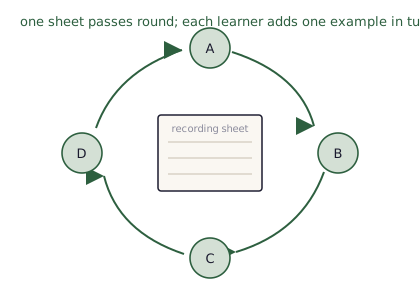
Why it suits this lesson. The idea learners most often miss is that the same change in momentum can give very different forces depending on the contact time. Round Table aims for breadth, surfacing many everyday examples, and each pass is one named contribution, which gives equal participation.
What to head off, and how
| Trap learners fall into | Teaching move that pre-empts it |
|---|---|
| Forgetting that momentum is a vector. | In a rebound the velocity reverses, so the change in momentum is larger than it first appears; use a sign convention. |
| Using speeds without signs in a collision. | Choose a positive direction first; a rebound speed takes the opposite sign. |
| Believing a longer impact time means a larger force. | For the same change in momentum, a longer time means a smaller force, since F = Δp / Δt. |
| Confusing impulse with momentum itself. | Impulse is a change in momentum (F Δt = Δp), not the momentum a body has. |
Support, challenge and the checks
- Support: a sign-convention reminder and a before-and-after velocity diagram for the rebound problems.
- Challenge: find an impulse from a triangular force-time graph and use it to find the final speed of an object that started at rest.
- Language: rehearse the frames "taking ... as positive, Δp = ..." and "longer time, so smaller force" before learners write.
Assessment is formative. Exit ticket question 1: a 0.45 kg ball is kicked from rest to 24 m s−1 in 0.010 s, find the average force on the ball. Exit ticket question 2: explain, in terms of impulse, why bending the knees on landing reduces the force on the legs. The group's Round Table sheet shows that every learner has added an example and a reason.
Equipment and resources
- the Round Table recording sheet and one pen per group, and the worksheet from this bundle
- a sign-convention reminder for support, and the exit ticket from the final slide
- the site simulation Conservation of Momentum, and the student topic page Newton's laws and momentum