Everyone adds, in turn
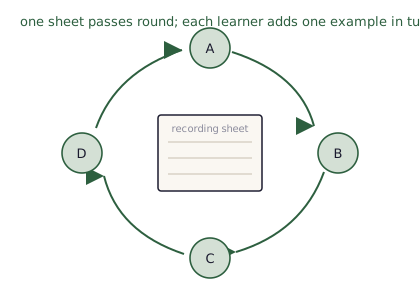
In a Round Table the group shares one sheet and one pen. Each learner writes one entry and passes the sheet on, so the page fills with a contribution from everyone. Here the prompt is a situation where the time of a collision or push changes the force, with a one-line reason, exactly the idea learners most often miss: that the same change in momentum can give very different forces depending on the contact time.
It passes the PIES test:
One sheet and one pen per group, so the record is genuinely shared and built together.
Each pass is one named contribution, so the sheet shows what every learner added.
The pen moves on after each entry, so no learner can dominate or opt out.
Every group is passing and writing at once, then sorting their examples together.
Pass, write, pass again
Give each group a single recording sheet and the prompt: a situation where the time of a collision or push changes the force.
In turn, each learner writes one example and a one-line reason, then passes the sheet to the left.
Keep passing, aiming for breadth rather than long answers, until the sheet is well filled.
The group sorts its examples into those that lengthen the time to reduce the force and those that shorten it to increase the force.
One row each, then pass
Each learner adds one row in turn. Pass the sheet after each entry.
| Name or initials | Example | Reason (how time changes the force) |
|---|---|---|
Teacher example bankclick to reveal
- Airbag in a car: extends the stopping time, so the force on the passenger is smaller.
- Crumple zone: the car body collapses, lengthening the impact time and reducing the force.
- Bending the knees on landing: lengthens the time to stop, reducing the force on the legs.
- Crash mat or thick gym mat: increases the time to stop a falling person.
- Catching a fast ball by drawing the hands back: longer catch time, smaller force.
- Packaging and bubble wrap: lengthens the impact time on a fragile item.
- A hammer striking a nail: a very short contact time gives a large force on the nail.
- A karate strike or a kicked football: a brief, forceful contact delivers a large impulse quickly.
- A golf or tennis follow-through keeps contact long enough to add momentum, while the strike itself is brief.
Note for discussion. In every case the change in momentum is fixed by the situation; it is the contact time that sets the force, since F = Δp / Δt.
When the room does not behave like the plan
One learner writes most of it: the pen moves on after each entry; enforce the pass so every learner adds a row.
Reasons are missing: an example without a reason does not count; insist on the one-line reason in each row.
The group runs dry: prompt with a category, such as sport, cars or packaging, to unlock more examples.
Short on time: the writing and the final sort are the heart of it; protect those over a long share-out.
- Support: seed the sheet with one example in each category so the group sees the two directions.
- Challenge: ask the group to estimate, for one example, the change in momentum and the rough force for a short and a long contact time.