The shape of the lesson
By the end of the lesson, learners can
- state Newton's first law and explain it using the idea of inertia
- understand mass as a measure of inertia and distinguish mass from weight, with W = m g
- state and use Newton's second law, F = m a for constant mass, as a special case of force as the rate of change of momentum
- state Newton's third law and identify the two forces in a third-law pair
- apply the laws to simple situations involving resultant force and equilibrium
Key vocabulary
resultant force, inertia, mass, weight, newton, second law F = m a, third-law pair, equilibrium. Each term is introduced as it is first needed.
Three laws, and mass versus weight
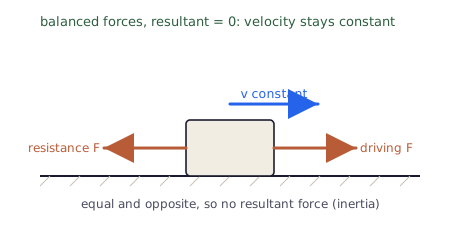
The first law says an object stays at rest or moves at constant velocity unless acted on by a resultant force, which is the idea of inertia. The second law says the resultant force equals the rate of change of momentum, and for constant mass this is F = m a, with the acceleration in the direction of the resultant force. The third law says that if A exerts a force on B, then B exerts an equal and opposite force on A, the two forces acting on different bodies and being of the same type.
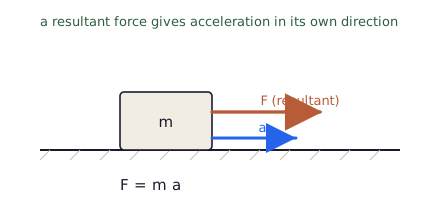
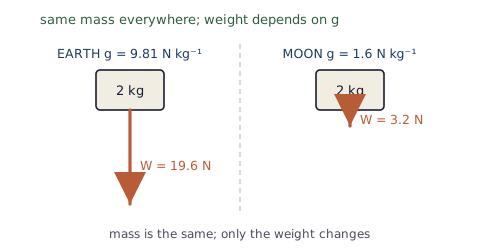
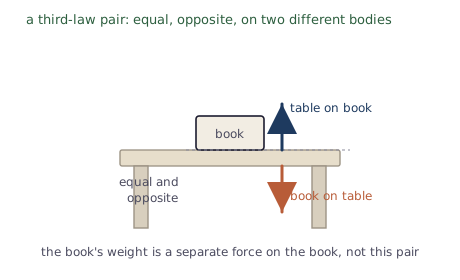
Mass is a measure of inertia, a scalar in kilograms, the same everywhere. Weight is the gravitational force on the body, W = m g, a vector in newtons that varies with g, so the same mass has different weights on Earth and the Moon. A third-law pair always acts on two different bodies; balanced forces on one body, such as a book's weight and the table's push, are not a pair.
Sixty minutes, phase by phase
| Time | Phase | What happens in the room | Resources |
|---|---|---|---|
| 0 to 5 min | Starter | Ask why a passenger lurches forward when a car brakes suddenly; draw out inertia. | Slide 1, fig-newton-first |
| 5 to 20 min | Teach: the three laws | State and explain the three laws with everyday examples; learners classify examples by law. | Slides 2 to 7, fig-fma, fig-third-law |
| 20 to 28 min | Teach: mass and weight | Distinguish mass and weight; model W = m g on Earth and elsewhere. | Slides 8 to 9, fig-mass-weight |
| 28 to 50 min | Activity | Run the Frayer Model on mass and on weight; circulate and check the non-examples. | Frayer activity sheet, fig-frayer |
| 50 to 60 min | Plenary | Exit ticket, then review the most confused non-example. | Exit ticket slide |
Second law, mass and weight, third law
Example 1: the second law
A car of mass 1200 kg has a resultant forward force of 3000 N. Find its acceleration.
Example 2: mass and weight
An astronaut has a mass of 80 kg. Find the weight on Earth (g = 9.81 m s−2) and on the Moon (g = 1.6 m s−2).
Example 3: the third law
A book rests on a table. Identify a third-law pair, and explain why the book's weight and the table's push on the book are not a pair.
Frayer Model on mass and weight
Each group is given two four-box grids, one for mass and one for weight, with the boxes Definition, Characteristics, Examples and Non-examples. Groups fill the definition and characteristics, then the examples, and finally the non-examples, which are the heart of the task: they force the group to decide what the term is not. Groups then compare grids and resolve disagreement, especially over the non-examples. A full step-by-step facilitation guide, with both grids and a teacher model, is provided as the activity in this bundle, so it can be run faithfully.
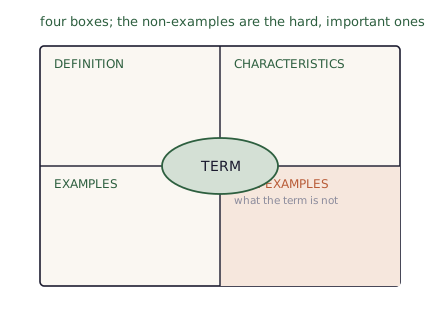
Why it suits this lesson. The deepest confusion in this topic is between mass and weight, and the non-examples box forces each learner to commit to a clear boundary for each term. Each box is initialled by whoever argued for it, which gives individual accountability and reveals whether the group truly understands the boundary.
What to head off, and how
| Trap learners fall into | Teaching move that pre-empts it |
|---|---|
| Treating mass and weight as the same, or giving a weight in kilograms. | Weight is a force in newtons; mass is in kilograms and is the same everywhere. |
| Believing a moving object needs a continuous force to keep moving. | With no resultant force the object keeps a constant velocity (the first law). |
| Thinking a third-law pair acts on the same body. | The two forces in a pair act on different bodies and are of the same type. |
| Confusing balanced forces on one body with a third-law pair. | A book's weight and the table's push both act on the book, so they are balanced forces, not a pair. |
Support, challenge and the checks
- Support: sentence starters for the Frayer non-examples, for example "a non-example of weight is ...".
- Challenge: for several situations, name both forces in the third-law pair and state the body each acts on.
- Language: rehearse the frames "mass is ... in kilograms" and "weight is ... in newtons" before learners write.
Assessment is formative. Exit ticket question 1: a 6.0 kg object has a resultant force of 18 N, find its acceleration. Exit ticket question 2: state one difference between mass and weight, including the unit of each. Each group's two Frayer grids and the initialled non-examples make the boundary of each term visible.
Equipment and resources
- the Frayer Model activity sheet (mass and weight), and the worksheet from this bundle
- sentence starters for support, and the exit ticket from the final slide
- the site simulation Force, Mass and Acceleration, and the student topic page Newton's laws of motion