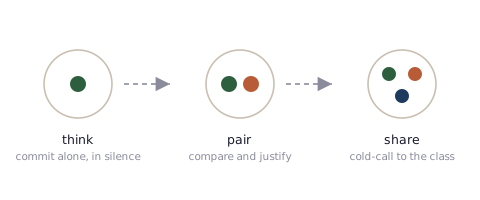
Think alone, pair to compare, share to the class
The teacher poses a prompt, ideally one that exposes a misconception. Each learner thinks alone and jots a brief answer in silence, then pairs compare reasoning and agree a shared answer. The teacher then cold-calls pairs to share, and the disagreement is resolved as a class. The silent think means every learner forms a view first, so the discussion is not dominated by the quickest hand.
It passes the PIES test:
Pairs must agree a shared answer, so each partner relies on the other's reasoning.
The silent think makes every learner commit to a view first, and any pair may be cold-called to justify it.
Pairing puts half the class talking at once, and both partners must contribute to the shared answer.
All pairs discuss at the same time, so a large share of the class is reasoning aloud.
About twenty minutes, three prompts
Reveal one prompt at a time, ideally one that exposes a misconception.
Each learner thinks alone and jots a brief answer, with no talking.
Learners pair up, compare reasoning, and agree a shared answer.
Cold-call two or three pairs to share, then settle the disagreement as a class. Move to the next prompt.
Sentence frames for the share
The teacher's role during the activity
Protect the silent think; it is what makes the discussion honest. While pairs talk, listen for the misconception each prompt targets, then choose which pairs to cold-call so the class hears both a wrong and a right line of reasoning before you settle it.
Each one targets a misconception
Teacher notes and answersclick to reveal
only true if the forces act in the same direction. The resultant ranges from 5 − 3 = 2 N (opposite directions) to 5 + 3 = 8 N (same direction). If the two forces are perpendicular, the resultant is √(52 + 32) = √34 = 5.8 N. Key point: the resultant of two fixed vectors depends on the angle between them.
the horizontal component moves the box along the ground, found from F cos θ = 20 × cos 30° = 17 N. The vertical component, 20 × sin 30° = 10 N, acts upward and does not move the box horizontally.
the displacement is the resultant of two perpendicular vectors. Magnitude = √(3.02 + 4.02) = √25 = 5.0 m; direction tan θ = 4.0 / 3.0, so θ = 53° north of east. Encourage a tip-to-tail sketch before the calculation.
When the room does not behave like the plan
Learners talk during the think: the silent think is the point; insist on a written jot before any pairing.
One partner dominates the pair: ask each pair to be able to give the other partner's reasoning, not just their own.
No pair will volunteer: cold-call by pair, not by individual, so the responsibility is shared.
A prompt is settled too fast: ask for the case that breaks the quick answer, for example perpendicular forces in Prompt 1.
- Support: give a labelled right-angled triangle template so pairs can sketch before they reason.
- Challenge: for Prompt 1, ask pairs to find the angle that makes the resultant exactly 6 N.