The shape of the lesson
By the end of the lesson, learners can
- define tensile stress and tensile strain, and state the unit of each
- define the Young modulus and use E = stress ÷ strain
- calculate tensile stress, tensile strain and the Young modulus for a wire
- interpret a stress-strain graph, including the limit of proportionality and the elastic and plastic regions
- describe an experiment to determine the Young modulus of a metal in the form of a wire
- explain that the Young modulus is a property of the material, not of the dimensions of the sample
Key vocabulary
tensile stress, tensile strain, the Young modulus, pascal, limit of proportionality, elastic limit, elastic and plastic deformation, stiffness, strength, cross-sectional area. Each term is introduced as it is first needed.
Three definitions, one material property
Stress is the load shared over the cross-section; strain is the fractional stretch; the Young modulus is the ratio of the two. Setting them out together makes the units fall into place: stress is in pascals, strain is a pure ratio, so the Young modulus is also in pascals.
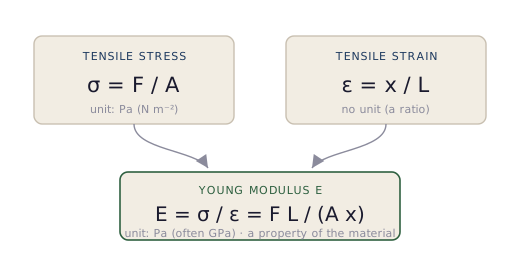
| Quantity | Equation | Unit |
|---|---|---|
| Tensile stress, σ | σ = F / A | Pa (N m−2) |
| Tensile strain, ε | ε = x / L | none (a ratio) |
| Young modulus, E | E = σ / ε = F L / (A x) | Pa (often GPa) |
| Area of wire, A | A = π d2 / 4 | m2 |
| Elastic strain energy | Ep = ½ F x = ½ k x2 | J |
Read the graph, and keep the material separate from the specimen
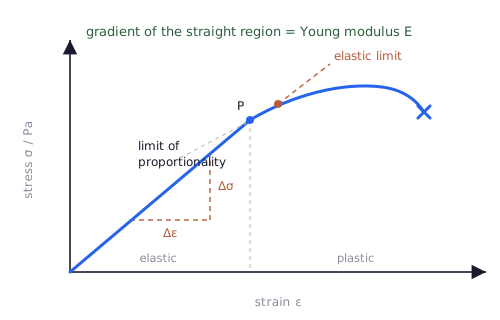
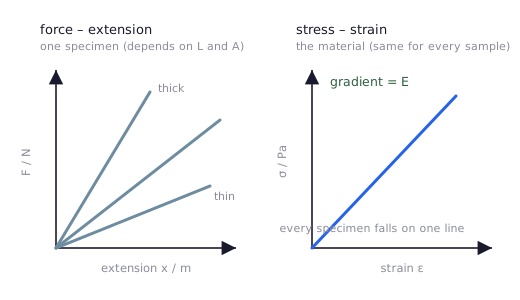
The Young modulus is the gradient of the straight region of the stress-strain graph, up to the limit of proportionality. Beyond the elastic limit the deformation is plastic and the wire no longer returns to its original length. The key distinction to protect: a force-extension graph belongs to one specimen and depends on its length and thickness, while a stress-strain graph belongs to the material and is the same for every sample.
Sixty minutes, phase by phase
| Time | Phase | What happens in the room | Resources |
|---|---|---|---|
| 0 to 5 min | Starter | Three true-or-false statements on stiffness, strength and the units of strain. Learners decide individually, then show hands; hold the disagreements for later. | Slides 1 to 2 |
| 5 to 10 min | Recap | Recall Hooke's law and the force-extension graph; define the limit of proportionality. Learners sketch a force-extension line and label it. | Slide 3 |
| 10 to 25 min | Teach | Define stress, strain and the Young modulus; build the stress-strain graph; contrast it with the force-extension graph for one specimen. | Slides 4 to 8, fig-stress-strain |
| 25 to 30 min | Model | Work the steel-wire example on the board, setting out method and units; learners predict each next step. | Slide 9, worked example below |
| 30 to 48 min | Activity | Numbered Heads Together on the team problem set; groups solve until every member can explain, then a random number is called. | Numbered Heads activity sheet |
| 48 to 55 min | Experiment | Walk through the Young modulus of a wire experiment and its main uncertainty: what to plot, and why the diameter dominates the error. | Slides 10 to 12, fig-wire-experiment |
| 55 to 60 min | Plenary | Exit ticket: one calculation and one explanation, completed individually and handed in. | Exit ticket on the final slide |
A steel wire, step by step
A steel wire of original length L = 2.00 m and diameter d = 0.50 mm stretches by x = 2.0 mm when a load F = 40 N is applied. Find the stress, the strain and the Young modulus.
The Young modulus of a wire
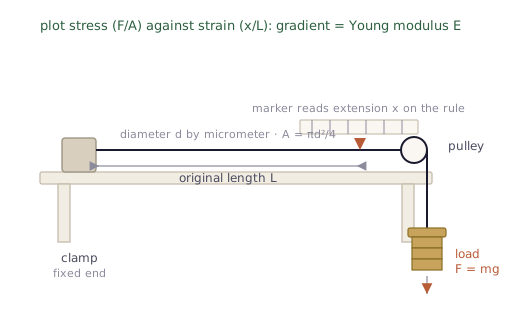
A long thin metal wire is clamped at one end and run horizontally over a pulley at the edge of the bench (or hung vertically), with a reference marker on the wire over a rule, and slotted masses providing the load. The aim is to load the wire in steps, record the extension, and find E from the gradient.
Method
- measure the original length L from the clamp to the marker with a metre rule
- measure the diameter d with a micrometer at several points and in two directions; take the mean and find A = π d2 / 4
- add masses in steps; for each load F = m g, record the extension x of the marker
- plot stress (F / A) against strain (x / L); the gradient of the straight-line region is the Young modulus. Equivalently plot F against x, where the gradient equals E A / L, so E = gradient × L / A
Precautions and uncertainty
- keep loads below the limit of proportionality so the wire returns to its original length
- the diameter is the largest source of uncertainty: because A depends on d2, the percentage uncertainty in d is doubled in the area
- use a long, thin wire so the extension is large enough to measure; wear eye protection and pad the floor beneath the masses
Numbered Heads Together
Learners work in groups of four and number off 1 to 4. The teacher poses one problem from the set; the group works until every member can explain the answer, not just write it. A random number is then called, and that learner answers for the group with no further help. Because the responder is chosen at random after discussion, no learner can hide and no single voice can dominate. A full step-by-step facilitation guide, with the team problem set and the teacher answer key, is provided as the activity in this bundle, so it can be run faithfully, including by a cover teacher.
Why it suits this lesson. The hard part of 6.1 is reasoning through multi-step calculations and the stiffness-versus-strength distinction. The structure forces that talk and keeps every learner accountable for the method and the units, not just the final value.
What to head off, and how
| Trap learners fall into | Teaching move that pre-empts it |
|---|---|
| "A thicker or shorter wire has a larger Young modulus." | The Young modulus is a material constant; it does not depend on the sample's dimensions. A thicker wire is stiffer as a specimen, but the ratio stress ÷ strain is unchanged. |
| Confusing strength with stiffness. | A high Young modulus means stiff (hard to stretch), not strong (high breaking stress). Keep the two graphs and the two words apart. |
| Treating the stress-strain graph as a force-extension graph. | The stress-strain graph is a property of the material; the force-extension graph is a property of that one specimen. Use fig-specimen-vs-material to separate them. |
| Giving strain a unit. | Strain is a ratio of two lengths, so it has no unit. Check this on every answer. |
| Using diameter where radius is needed, or forgetting A depends on d2. | A = π d2 / 4 (equivalently π r2). Doubling d quarters the stress for a given load, so the extension changes a lot. |
Support, challenge and the checks
- Support: a part-completed method frame and a units checklist; allow the formula triangle for E = σ / ε.
- Challenge: derive E = F L / (A x) from the definitions, and evaluate the effect of doubling the diameter on the extension for a fixed load.
- Language: rehearse the frames "stiffness is ..., strength is ..." and "the Young modulus is the gradient of ..." before learners write.
Assessment is formative. Exit ticket question 1 (calculation): a wire of area 2.0 × 10⁻⁷ m2 and length 1.5 m extends 0.90 mm under a 30 N load; find the Young modulus. Exit ticket question 2 (explanation): in one sentence, explain why two wires of the same metal but different thickness have the same Young modulus. Random call after Numbered Heads Together gives a quick read on individual understanding.
Equipment and resources
- a long thin metal wire, a clamp and a pulley, a metre rule, a micrometer screw gauge, a reference marker and slotted masses
- the worksheet, the activity problem set and the exit ticket from this bundle
- the site simulation Stretching a Wire, and the student topic page Stress, strain and the Young modulus