Solve together, anyone explains
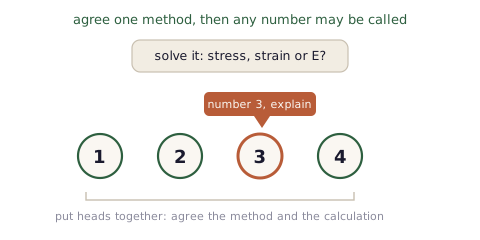
In Numbered Heads Together, each learner in a group of four takes a number. The teacher reveals one problem; the group works until every member can explain the answer, not just write it. The teacher then calls a random number, and that learner answers for the group with no further help. Because nobody knows in advance who will be called, every member has to understand the method and the units, not just the most confident one.
It passes the PIES test:
The group must agree one method and calculation together, because any member may have to explain it for the group.
A number is called at random, so each member is accountable for the working and the units, not just the value.
Every member numbers off and attempts the problem, so each has a view before the group agrees.
All groups work at once, so every learner is calculating and reasoning.
About eighteen minutes, six problems
In each group of four, members take a number from 1 to 4.
Show one problem from the team set at a time. Keep the useful relationships on display.
The group works until every member can explain the answer, with method and units, not just a value.
Call a number from 1 to 4; that learner answers for the group with no further help. Award a point for a correct, clearly explained answer, then move on.
Sentence frames for the answer
The teacher's role during the activity
Keep the rounds brisk. Circulate and listen for the key moves: the right equation, a clean substitution, and the correct unit. Choose a different number each round so accountability is real. Aim for about eighteen minutes for the six problems; skip Q6 if time is short and use it as a stretch.
Six problems, one set per group
Teacher answer keyclick to reveal
stress is the force per unit cross-sectional area, σ = F / A; unit pascal, Pa (N m−2). Strain is the extension per unit original length, ε = x / L; no unit (a ratio).
σ = F / A = 60 / (2.0 × 10⁻⁷) = 3.0 × 10⁸ Pa (300 MPa).
ε = x / L = (1.2 × 10⁻³) / 1.50 = 8.0 × 10⁻⁴.
A = π d2 / 4 = π (0.40 × 10⁻³)2 / 4 = 1.26 × 10⁻⁷ m2.
σ = F / A = 25 / (1.26 × 10⁻⁷) = 1.99 × 10⁸ Pa.
ε = x / L = (1.8 × 10⁻³) / 1.80 = 1.0 × 10⁻³.
E = σ / ε = (1.99 × 10⁸) / (1.0 × 10⁻³) = 2.0 × 10¹¹ Pa (200 GPa).
(i) P is the limit of proportionality. (ii) the Young modulus is the gradient of the straight-line region. (iii) the region beyond the elastic limit represents plastic (permanent) deformation: the wire does not return to its original length when unloaded.
incorrect. The Young modulus is a property of the material, not of the dimensions of the sample. The thicker wire has a larger cross-sectional area, so for the same force it has a smaller stress and stretches less (it is stiffer as a specimen), but the ratio stress / strain is the same for both because the material is the same.
When the room does not behave like the plan
One member answers for everyone: remind the group that any number may be called, so all four must agree and be able to explain.
A group gives a value with no working: ask for the equation, the substitution and the unit, not just the number.
An odd group of three: use numbers 1 to 3, or give one member two numbers.
It runs long: four problems are enough; keep Q6 as a stretch and protect the experiment and the exit ticket.
- Support: a part-completed method frame and a units checklist; allow the formula triangle for E = σ / ε.
- Challenge: derive E = F L / (A x) from the definitions, and reason about the effect of doubling the diameter on the extension for a fixed load.