Define tensile stress and give its unit.
Define tensile strain and explain why it has no unit.
Write the equation that defines the Young modulus and give its unit.
True or false? Correct any that are false.
A wire of cross-sectional area 3.0 × 10⁻⁷ m2 carries a load of 45 N. Calculate the stress.
A wire of original length 2.50 m extends by 2.0 mm. Calculate the strain.
A wire of diameter 0.60 mm and length 1.60 m extends by 1.0 mm under a load of 30 N. Calculate:
A metal has a Young modulus of 1.2 × 10¹¹ Pa. A wire of this metal, of area 1.5 × 10⁻⁷ m2 and length 2.0 m, carries a load of 18 N. Calculate the extension.
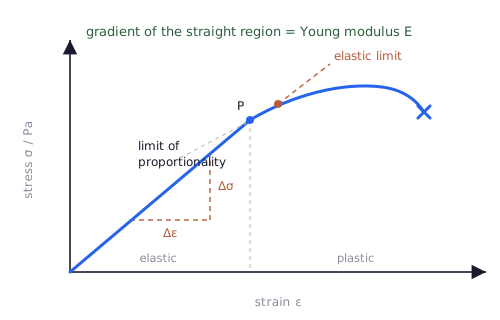
The figure shows a stress-strain graph for a metal wire.
Describe how you would determine the Young modulus of a metal in the form of a wire. In your answer include:
A wire obeys Hooke's law. A force of 20 N produces an extension of 1.5 mm.
Total: 38 marks. Original work by the TheLucidSTEM team. Written in the style of the papers; no past paper question is reproduced.
Answer key · full worked solutionsclick to reveal
stress is the force per unit cross-sectional area, σ = F / A; unit pascal, Pa (N m−2).
strain is the extension divided by the original length, ε = x / L. It is a ratio of two lengths, so it has no unit.
E = stress / strain = σ / ε; unit pascal, Pa.
(a) False: strain has no unit. (b) True. (c) False: strength (breaking stress) and stiffness (the Young modulus) are different properties.
σ = F / A = 45 / (3.0 × 10⁻⁷) = 1.5 × 10⁸ Pa.
ε = x / L = (2.0 × 10⁻³) / 2.50 = 8.0 × 10⁻⁴.
(a) A = π d2 / 4 = π (0.60 × 10⁻³)2 / 4 = 2.83 × 10⁻⁷ m2.
(b) σ = F / A = 30 / (2.83 × 10⁻⁷) = 1.06 × 10⁸ Pa.
(c) ε = x / L = (1.0 × 10⁻³) / 1.60 = 6.25 × 10⁻⁴.
(d) E = σ / ε = (1.06 × 10⁸) / (6.25 × 10⁻⁴) = 1.7 × 10¹¹ Pa (170 GPa).
rearrange E = F L / (A x) to give x = F L / (A E).
x = (18 × 2.0) / (1.5 × 10−7 × 1.2 × 1011) = 36 / (1.8 × 10⁴) = 2.0 × 10⁻³ m = 2.0 mm.
(a) the limit of proportionality is the end of the straight-line region; the elastic limit is just beyond it, the last point from which the wire still returns to its original length.
(b) elastic behaviour up to the elastic limit; plastic behaviour beyond it.
(c) E = gradient = (8.0 × 10⁸) / (4.0 × 10⁻³) = 2.0 × 10¹¹ Pa (200 GPa).
marking points (one mark each, any six): measure the original length L with a metre rule to a reference marker; measure the diameter d with a micrometer at several points and directions, then average; calculate A = π d2 / 4; add known masses and record the extension x for each load F = m g; plot stress against strain (or F against x); the Young modulus is the gradient of the linear region of the stress-strain graph (or gradient × L / A for an F against x graph); the diameter gives the largest uncertainty because A depends on d2, so the percentage uncertainty in d is doubled; keep below the limit of proportionality.
(a) energy = ½ F x = ½ × 20 × (1.5 × 10−3) = 1.5 × 10⁻² J (0.015 J).
(b) assumption: the wire obeys Hooke's law (it is loaded within the limit of proportionality), so force is proportional to extension.
(c) the energy equals the area under the force-extension graph. For a Hooke's law wire this area is a triangle, ½ × base × height = ½ x F.