(a) State the approximate value of the acceleration of free fall g near the Earth, with its unit. (b) State what is meant by free fall.
A hammer and a feather are dropped together inside a tube with the air removed. State what is seen, and explain why.
Taking g = 10 m/s², a stone falls from rest. (a) Find its speed after 3 s. (b) Find its speed after 5 s.
The speed-time graph below shows an object in free fall (taking g = 10 m/s²).
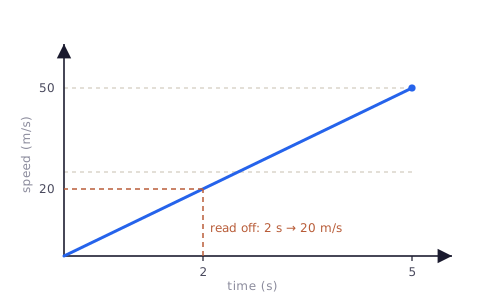
(a) Describe the motion shown. (b) Find the gradient of the line and state what it represents. (c) What is the speed after 2 s?
A feather falls slowly in air, but a stone falls quickly. A student says "gravity is stronger on the stone." Explain why this is wrong.
Taking g = 9.8 m/s², find the speed of a freely falling object 2 s after it is released from rest.
Total: 15 marks. Original work by the TheLucidSTEM team. Written in the style of the papers; no past paper question is reproduced.
Answer key · full worked solutionsclick to reveal
(a) g is about 9.8 m/s² (10 m/s² is accepted).
(b) free fall is motion under gravity alone, with no air resistance.
they fall at the same rate and land together. With no air resistance both have the same acceleration g; the acceleration of free fall does not depend on mass.
(a) v = g t = 10 × 3 = 30 m/s.
(b) v = g t = 10 × 5 = 50 m/s.
(a) the speed increases at a steady rate from rest: constant acceleration (free fall).
(b) gradient = 50 ÷ 5 = 10 m/s²; it represents the acceleration of free fall, g.
(c) at 2 s the speed is 20 m/s.
gravity gives both objects the same acceleration g. The feather is slow because of air resistance, not because gravity is weaker; remove the air and the feather keeps pace with the stone.
v = g t = 9.8 × 2 = 19.6 m/s.