The shape of the lesson
By the end of the lesson, learners can
- define density as mass per unit volume
- recall and use the relation ρ = m / V, including rearranging it to find mass or volume
- state and use the units grams per cubic centimetre (g/cm³) and kilograms per cubic metre (kg/m³)
- compare the density of an object with the density of a liquid to predict whether it floats or sinks
- determine whether one liquid will float on another, given that the two liquids do not mix, by comparing their densities
Key vocabulary
density, mass, volume, particle, packed and spread, grams per cubic centimetre (g/cm³), kilograms per cubic metre (kg/m³), float, sink, displacement (previewed for the measuring lesson).
One picture every idea returns to
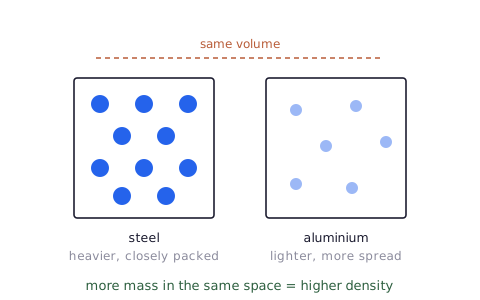
Every density idea in this lesson returns to one picture: the two cubes from the hook, steel and aluminium, drawn at equal volume. Steel holds more mass in the same space, so it has the higher density. Between two different materials that extra mass comes from two things together: each steel particle is heavier than each aluminium particle, and the particles also sit more closely packed. Because the volume is fixed, ρ = m / V is read straight off the picture: more mass in the same volume gives a higher density. Packing alone changes density only within a single material, for example a gas compared with the same substance as a liquid.
Forty-five minutes, phase by phase
| Time | Phase | What happens in the room | Grouping |
|---|---|---|---|
| 0 to 6 min | Hook: predict | Two identical sized cubes, aluminium and steel, are shown and ideally compared on a balance. Learners predict which is heavier and, in one sentence, why. Reveal: same size, very different mass. | Think, Pair, Share |
| 6 to 19 min | Build the model | The two cube model from the hook is drawn. Steel holds more mass in the same volume because its particles are heavier and sit more closely packed. Density is defined as mass per unit volume and ρ = m / V is read off the picture. The unit is fixed first. One worked example is modelled (density from a measured mass and volume) and one rearrangement is modelled live (mass = density × volume). | Whole class, teacher led |
| 19 to 35 min | Main: Rally Coach | In pairs, partners take turns: one solves a problem out loud while the other coaches and checks each line, then they swap. The set runs from direct density calculations, through the volume rearrangement, to a stretch comparing two liquids that do not mix to predict which floats. A learner is called at random to explain one solution. | Pairs (Rally Coach) |
| 35 to 40 min | Practical link | Teacher demonstration: a regular block is measured, its dimensions giving volume = length × width × height and the balance giving mass, and the class computes the density together. This ties the calculation to a real measurement and previews the measuring lesson. | Teacher demo |
| 40 to 45 min | Plenary and exit | Exit ticket: one density calculation and one float or sink reasoning item (for example, will a block of density 0.7 g/cm³ float in water, and why). Both are Core. Learners self assess against the objectives. | Individual |
Protect the parts that carry the learning
This lesson carries about 50 to 55 minutes of material, so the 45 minute version is deliberately demonstration based and one rearrangement is left for the paired task. Times are a guide and stretch comfortably across a longer block.
Protected: the plenary exit ticket. It is the only individual check of the Core outcomes and is not cut.
Cut first if the build overruns: the liquid on liquid stretch at the end of the Rally Coach set, never the consolidation or the plenary.
In a 60 minute block: run the practical as a genuine pairs measurement (distribute a block, measure three dimensions, find the mass, compute the density) and model both rearrangements live.
Think-Pair-Share, then Rally Coach
Think, Pair, Share (the hook). Learners think alone for about thirty seconds and write a one sentence prediction, compare with a partner, then a few predictions are shared with the class. Predicting before the reveal surfaces the heavy means sinks idea early, where it can be addressed.
Rally Coach (the main). Pairs sit side by side with one worksheet between them. For each problem one partner is the solver and the other is the coach. The solver talks through every step while writing; the coach watches, checks each line, and offers a tick or a prompt, never the answer. Partners swap roles for the next problem, so both solve and both coach. Since either partner may be called at random to explain any solution, both stay accountable for the whole set. Pair a confident calculator with a developing one and let the coaching role carry the support.
What to head off, and how
| Trap learners fall into | Teaching move that pre-empts it |
|---|---|
| Confusing density with mass. | Return to the cubes: two objects can share a mass yet differ in density when their volumes differ. Density compares mass to the space it occupies. |
| Thinking density differences are only about how tightly particles are packed. | Packing alone changes density within one material (a gas compared with its liquid). Between different materials each particle also has a different mass. The steel and aluminium cubes carry both effects together. |
| Mixing grams per cubic centimetre with kilograms per cubic metre. | Fix the unit before calculating and write it with every answer. Show the relationship once, 1 g/cm³ = 1000 kg/m³, and keep it on display. Both units are Core. |
| Rearranging the relation incorrectly. | Model density = mass ÷ volume, mass = density × volume, and volume = mass ÷ density side by side, and check each by substituting the answer back. |
| Assuming heavy objects always sink. | Use the steel ship in the plenary as the counterexample. What decides floating is density compared with the liquid, not mass alone. |
Support, challenge and the checks
- Support: a worked density example to copy, a formula triangle for the rearrangement, and problems that begin with the mass and volume already measured.
- Challenge: comparing two liquids that do not mix to predict which floats (the Supplement skill), the density of an object that itself floats (so it cannot simply be fully submerged), and harder unit conversions between g/cm³ and kg/m³.
- Language: rehearse the frames "the density is found by dividing the mass by the ..." and "this material is denser because it has more mass in the same ..." before learners write.
Assessment is formative. The exit ticket maps directly to the Core objectives: one calculation item and one float or sink reasoning item. Random call after the Rally Coach set gives a quick read on individual understanding.
Equipment and resources
- two equal sized cubes of different materials (aluminium and steel work well), a balance, a ruler, and one regular block to measure
- the slides, worksheet with answer key, and prediction or expert cards from this bundle
- PhET Density and PhET Buoyancy for an optional simulation extension