The shape of the lesson
By the end of the lesson, learners can
- read a distance-time graph and state what a horizontal, a sloped and a curved section show
- recognise that the gradient of a distance-time graph is the speed
- calculate a speed from a distance-time graph using a large gradient triangle
- sketch a distance-time graph for a described journey
- tell a distance-time graph from a speed-time graph by reading the axes first
Key vocabulary
distance-time graph, gradient, speed, stationary, constant speed, uniform motion, curve, large triangle, axes. Each term is introduced as it is first needed.
One picture the whole unit shares
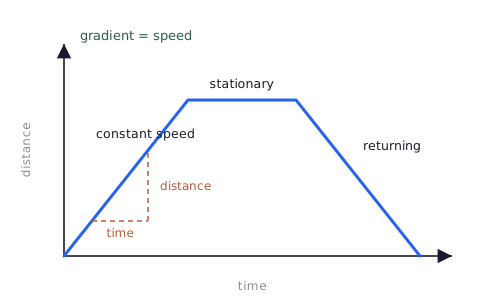
The unit shares one picture, the twin-graph poster, and this lesson builds its distance-time side. One journey is drawn as distance against time: a straight slope for constant speed, a horizontal line while stationary, and a downward slope on the return. The gradient of the line is the speed, found with a large triangle. The simulation The Round Trip Trap supplies the motion: the distance keeps rising even on the way back, which is exactly what a distance-time graph shows, and which separates it from the speed-time graph to come.
Forty-five minutes, phase by phase
| Time | Phase | What happens in the room | Grouping |
|---|---|---|---|
| 0 to 5 min | Hook: the journey | The site simulation The Round Trip Trap runs on the board. Learners watch the distance travelled climb as the trip goes out, and keep climbing on the way back. The question: if we plotted distance against time, what shape would the graph have? | Whole class, sim on board |
| 5 to 16 min | Build the reading | The distance-time side of the poster is built feature by feature: a horizontal line is stationary, a straight slope is constant speed, a steeper slope is faster, and a curve is a changing speed (steepening is speeding up, flattening is slowing down). The gradient is the speed, found with a large triangle that spans most of the line. | Whole class, teacher led |
| 16 to 30 min | Think-Pair-Share | Learners match a set of described journeys to distance-time graphs: first alone (Think), then comparing and justifying with a partner (Pair), then a random call to the class (Share). The full facilitation, with the matching cards, teacher script and answer key, is in the activity materials in this bundle. | Pairs, Think-Pair-Share |
| 30 to 38 min | Check | On mini whiteboards, learners sketch a described journey (for example: walk steadily, wait, then walk back faster). A number is called and that learner explains their sketch. | Individual, then whole class |
| 38 to 45 min | Plenary and exit | Exit ticket: sketch a short described journey as a distance-time graph, and state in one line what a horizontal line means. Learners self assess against the objectives. | Individual |
Protect the parts that carry the learning
Matching and then sketching is the load here. Keep the build tight so the matching has its full time, and protect the sketch so the lesson ends on an individual check.
Protected: the exit ticket sketch. It is the only individual check of the Core outcome and is not cut.
If time is short: reduce the matching set to four cards and keep the Think and Pair phases, dropping the whole-class Share to a quick show of hands.
In a 60 minute block: have learners plot a distance-time graph from the Lesson 1 data on graph paper, and calculate a speed from its gradient with a large triangle.
Think-Pair-Share, in brief
Each learner first matches the described journeys to the graphs alone (Think), then compares with a partner and justifies each choice (Pair), then the class shares through a random call (Share). The justifying in the Pair phase is where the reasoning becomes visible, a steeper line is faster, a horizontal line is stationary. A full step-by-step facilitation guide, with the matching cards, sentence stems, a teacher script and the answer key, is provided as the activity in this bundle, so the structure can be run faithfully.
Why it suits this lesson. Matching journeys to graphs is a recognition task with a clear right answer, ideal for a quiet first attempt, a paired justification, and a public share that surfaces the reasoning.
What to head off, and how
| Trap learners fall into | Teaching move that pre-empts it |
|---|---|
| Thinking a horizontal line means constant speed. | On a distance-time graph a horizontal line is stationary: the distance is not changing. Constant speed is a straight line that slopes. |
| Confusing a distance-time graph with a speed-time graph. | Read the axes first, every time. The same shape means different things on the two graphs. |
| Reading the gradient from two close points, or dropping units. | Use a large triangle that spans most of the line, and carry the units, so speed comes out in m/s. |
| Thinking a steeper line means further travelled. | A steeper line means faster, a greater speed. How far is read off the distance axis. |
| Reading a curve the wrong way. | A curve that steepens shows speeding up; a curve that flattens shows slowing down. |
Support, challenge and the checks
- Support: pre-drawn axes, a reduced set of four cards, and a word bank (stationary, constant speed, speeding up, slowing down).
- Challenge: a multi-stage journey to sketch, a speed found from a gradient with a large triangle, and a first look at how the same journey would appear on a speed-time graph.
- Language: rehearse "the gradient is the speed" and "a horizontal line means stationary" so the key readings are stated precisely.
Assessment is formative. Think-Pair-Share makes each learner commit and then justify; the mini-whiteboard sketch with random call tests an individual; and the exit ticket maps to the Core outcome, sketching a described journey.
Equipment and resources
- squared or graph paper, rulers, and mini whiteboards
- the Think-Pair-Share activity (with its facilitation guide), the worksheet and the exit ticket from this bundle
- the site simulation The Round Trip Trap (Unit 1 simulations); the student topic page Motion graphs