State what each of these shows on a distance-time graph: (a) a horizontal line; (b) a straight line that slopes upwards.
The distance-time graph below shows a short journey.
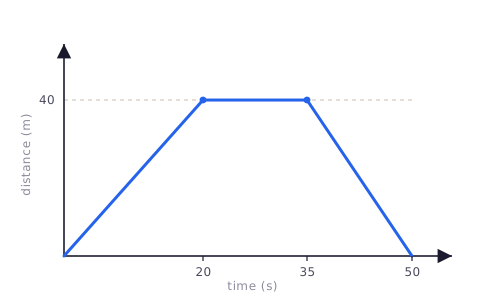
(a) Describe the motion between 20 s and 35 s. (b) Calculate the speed during the first 20 s. (c) Is the object faster or slower on the way back than on the way out? Give a reason.
A student says, "a horizontal line on a distance-time graph means the object moves at constant speed." Explain why this is wrong, and state what a horizontal line really means.
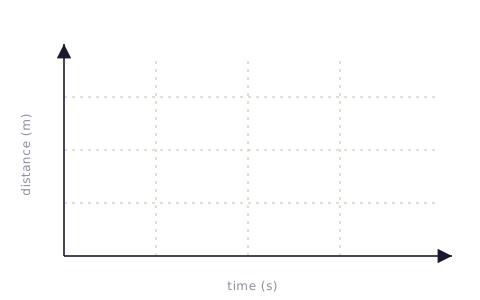
Sketch a distance-time graph for this journey: stationary for 10 s, then a constant speed away from the start for 20 s. Label the axes.
On a distance-time graph an object moves from 10 m to 70 m between 5 s and 25 s. Calculate its speed.
Describe the motion shown by (a) a curve that gets steeper, and (b) a curve that gets less steep.
Total: 15 marks. Original work by the TheLucidSTEM team. Written in the style of the papers; no past paper question is reproduced.
Answer key · full worked solutionsclick to reveal
(a) a horizontal line means the object is stationary (the distance is not changing).
(b) a straight sloped line means a constant speed.
(a) between 20 s and 35 s the line is horizontal, so the object is stationary.
(b) speed = gradient = 40 ÷ 20 = 2 m/s.
(c) faster on the way back: the return covers 40 m in 15 s (about 2.7 m/s), a steeper line than the outward 40 m in 20 s.
a horizontal line is not constant speed. The distance is not changing, so the object is stationary. Constant speed is shown by a straight line that slopes upwards.
expected shape: a horizontal line for the first 10 s (stationary), then a straight line sloping upwards for the next 20 s (constant speed). Axes labelled distance / m against time / s.
speed = gradient = (70 − 10) ÷ (25 − 5) = 60 ÷ 20 = 3 m/s.
(a) a curve that gets steeper shows the object speeding up.
(b) a curve that gets less steep shows the object slowing down.