Agree one answer everyone can give
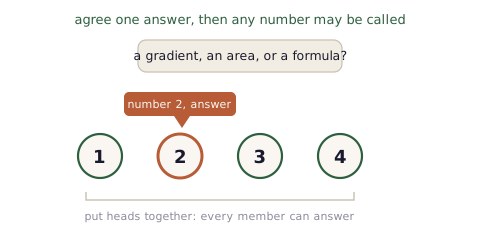
In Numbered Heads Together, learners sit in groups of four and number off 1 to 4. The teacher poses a question; the group puts heads together to agree one answer that every member can give; then a random number is called, and that learner answers for the whole group. Because nobody knows who will be called, every learner prepares every answer, which is exactly what an apply-and-assess lesson needs.
It passes the PIES test:
The group must make sure every member can answer, not just the most confident one.
A random number answers for the group, so each learner is on the hook.
Any of the four may be called, so all four prepare every answer.
Every group thinks at once, so the whole class is engaged.
Three things to prepare
- Display the twin-graph poster, and have the six rounds (below) ready to reveal one at a time.
- Arrange learners in groups of four and have them number off 1 to 4.
- Have a way to pick a random number: number cards, a dice, or a spinner.
About 20 minutes, step by step
Each group member takes a number, 1 to 4.
Reveal one round and start the clock.
The group agrees one answer and checks that every member can give it, with the working.
Name a number; that learner answers for the group. Other groups show a thumb to agree, or challenge.
Confirm the answer against the poster, then reveal the next round.
Teacher script stems
The teacher's role during the activity
Circulate during heads-together and make sure stronger members coach rather than dictate; the test of a good group is that the weakest member can still answer. Vary which number you call so that all four are used across the rounds.
When the room does not behave like the plan
One member dominates: require the group to check that every member can answer before time is up.
A group is stuck: give a poster hint, which axis is it, gradient or area, or which formula.
A wrong answer is called: thank them, take the working, and let another group complete it; the point is the shared preparation.
Uneven group: in a three, one learner takes two numbers.
- Support: keep the early rounds to one-step formulas and single graph readings.
- Challenge: add a two-step round, find a distance from a speed-time area, then use it to find an average speed.
Reveal one at a time; each maps to a part of the poster
A car travels 90 m in 6 s. What is its average speed?
On a distance-time graph, what does the gradient of the line tell you?
A bus speeds up from 4 m/s to 16 m/s in 4 s. What is its acceleration?
A runner holds a steady 6 m/s for 10 s. Use the area to find the distance travelled.
A train slows from 30 m/s to 10 m/s in 5 s. What is its deceleration?
What is the approximate acceleration of free fall near the Earth, and what are its units?
Each answer ties back to the poster
| Round | Worked answer |
|---|---|
| Round 1 | v = s ÷ t = 90 ÷ 6 = 15 m/s |
| Round 2 | the gradient is the speed |
| Round 3 | a = Δv ÷ Δt = (16 − 4) ÷ 4 = 12 ÷ 4 = 3 m/s² |
| Round 4 | distance = area = 6 × 10 = 60 m |
| Round 5 | a = (10 − 30) ÷ 5 = −4 m/s², so the deceleration is 4 m/s² |
| Round 6 | about 9.8 m/s² (accept 10 m/s²), measured in m/s² |