Teachers' Portal  /  Apply and assess: motion  /  Short test
Short test · IGCSE 0625 · 1.2 Motion · Core

Apply and assess: short test

Six original Core questions across the whole of 1.2. For each one, decide first which tool you need: a formula, the gradient, or the area. Give a unit with every value.

Download editable (.docx) Back to the bundle
Name: ________________Class: __________Date: __________
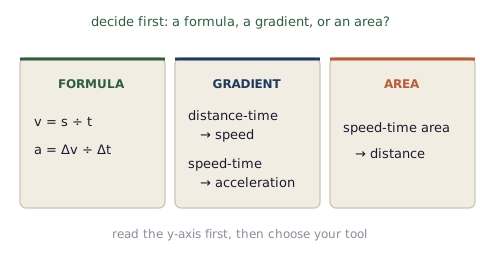
Choosing the tool: a formula, a gradient, or an area, with what each gives.
For each question, decide first: a formula, a gradient, or an area?
Q12 marks

A runner covers 200 m in 25 s. Calculate the average speed.

Q23 marks

A distance-time graph for a walk is a straight line from 0 to 60 m between 0 s and 12 s, then a horizontal line from 12 s to 20 s.

(a) Calculate the speed during the first 12 s. (b) Describe the motion from 12 s to 20 s.
Q32 marks

A car accelerates from 8 m/s to 20 m/s in 6 s. Calculate the acceleration.

Q43 marks

A speed-time graph shows a car rising from rest to 12 m/s in 4 s, then a constant 12 m/s for 6 s. Use the area to find the total distance travelled.

Q52 marks

A cyclist slows from 12 m/s to rest in 4 s. Calculate the deceleration.

Q63 marks

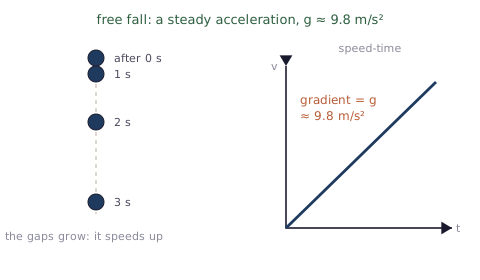
Free fall near the Earth's surface.

A dropped object speeding up, with a straight speed-time line of gradient about 9.8 metres per second squared.
A dropped object in free fall
(a) State the approximate acceleration of free fall near the Earth's surface. (b) A stone is dropped from rest. Ignoring air resistance, calculate its speed after 2 s.

Total: 15 marks. Original work by the TheLucidSTEM team. Written in the style of the papers; no past paper question is reproduced.

Answer key · full worked solutionsclick to reveal
Q1. Average speed.

v = s ÷ t = 200 ÷ 25 = 8 m/s.

Q2. Distance-time graph.

(a) speed = gradient = 60 ÷ 12 = 5 m/s.
(b) the line is horizontal, so the walker is stationary (not moving).

Q3. Acceleration.

a = Δv ÷ Δt = (20 − 8) ÷ 6 = 12 ÷ 6 = 2 m/s².

Q4. Distance from the area.

triangle (0 to 4 s): ½ × 4 × 12 = 24 m.
rectangle (4 to 10 s): 6 × 12 = 72 m.
total distance = 24 + 72 = 96 m.

Q5. Deceleration.

a = Δv ÷ Δt = (0 − 12) ÷ 4 = −3 m/s², so the deceleration is 3 m/s².

Q6. Free fall.

(a) about 9.8 m/s² (accept 10 m/s²).
(b) v = g t = 9.8 × 2 = 19.6 m/s (accept 20 m/s if g = 10 m/s² is used).

Marking note: give the unit mark only when m/s (speed), m/s² (acceleration) or m (distance) is stated. In Q4 award for the split into shapes and for the correct total.
Original work by the TheLucidSTEM team. Questions are written in the style of the papers; no past paper question is reproduced. Supplied in editable formats so you can adapt them freely.
Back to the lesson bundle