Explain, in your own words, what is meant by:
A converging lens has a focal length of 4.0 cm. For each object distance below, state whether the image is real or virtual, upright or inverted, and enlarged, same size or diminished.
Draw each diagram to scale on graph paper or a ruled axis, using a horizontal scale of 1 cm to 1 cm. The three-ray method is shown below (object beyond 2F).
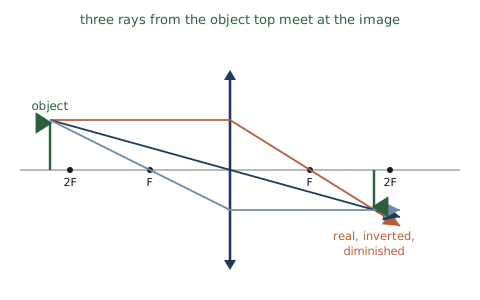
A lens has a focal length of 4.0 cm. An object 1.0 cm tall stands on the axis 8.0 cm from the lens. Construct a scale ray diagram, then state the image distance, the image height and the nature of the image.
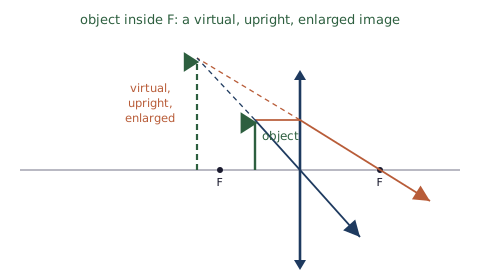
The same lens is used with the object moved to 2.0 cm from the lens. Construct the ray diagram for this case, describe the image fully, and explain why this arrangement is how the lens works as a magnifying glass.
An object 2.0 cm tall produces an image 6.0 cm tall through a converging lens.
To measure the focal length, a student focuses the image of a distant window onto a screen and records the lens-to-screen distance three times: 9.8 cm, 10.0 cm, 19.9 cm.
Total: 18 marks. Original work by the TheLucidSTEM team. Written in the style of the papers; no past paper question is reproduced.
Answer key · full worked solutionsclick to reveal
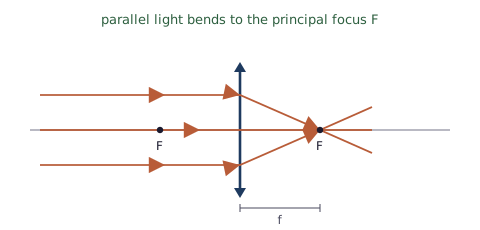
(a) the principal focus is the point on the principal axis to which rays travelling parallel to the axis converge after passing through the lens.
(b) the focal length is the distance from the centre of the lens to the principal focus.
(a) 12 cm is beyond 2F: real, inverted, diminished.
(b) 6 cm is between F and 2F: real, inverted, enlarged.
(c) 2 cm is inside F: virtual, upright, enlarged.
the image forms at 2F on the far side, so the image distance is 8.0 cm, the image height is 1.0 cm, and the image is real, inverted and the same size.
the object is inside the focal length, so the refracted rays diverge and are traced back to meet on the same side as the object. The image is virtual, upright and enlarged. This is the magnifying glass: the eye sees an enlarged upright image when the object is within one focal length of the lens.
(a) magnification = image height / object height = 6.0 / 2.0 = 3.0.
(b) magnification = image distance / object distance, so image distance = 3.0 × 5.0 = 15 cm.
(a) 19.9 cm is anomalous (close to double the other two; the screen was likely at the wrong position).
(b) using 9.8 cm and 10.0 cm, focal length = mean = 9.9 cm (accept about 10 cm).
(c) light from a distant object reaches the lens as an effectively parallel beam, so it converges at the principal focus; the image therefore forms at a distance equal to the focal length.