The shape of the lesson
By the end of the lesson, Extended learners can
- combine two perpendicular vectors to find their resultant
- find a resultant by scale drawing, joining the vectors tip to tail and measuring the length and direction
- calculate the magnitude of a resultant using Pythagoras
- calculate the direction of a resultant using the tangent ratio
- state a resultant with both a magnitude and a direction
Key vocabulary
vector, resultant, component, perpendicular, scale drawing, tip to tail, parallelogram, Pythagoras, tangent ratio, magnitude, direction, bearing. Each term is introduced as it is first needed.
Two methods, one triangle
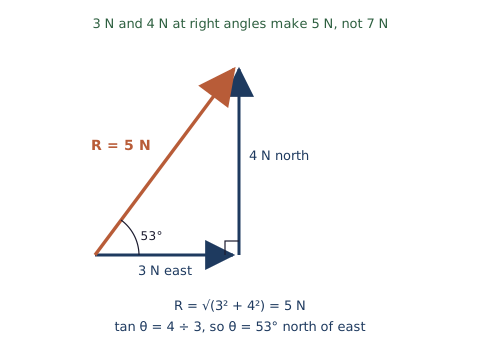
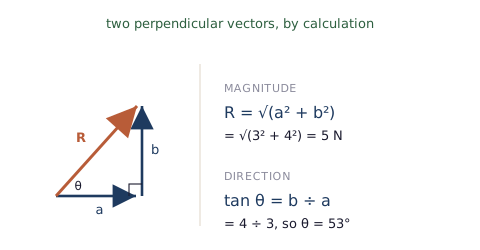
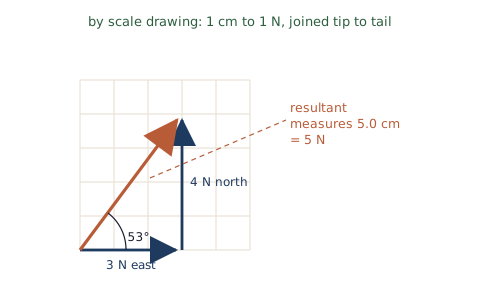
One picture carries the lesson: the vector triangle. Two perpendicular vectors are joined tip to tail, and the resultant runs from the start of the first to the tip of the second. The classic three and four example makes both methods concrete: by scale drawing the resultant measures 5 N, and by calculation Pythagoras gives the magnitude, R = √(3² + 4²) = 5 N, and the tangent ratio gives the angle, tan θ = 4 ÷ 3, so θ = 53°. The headline idea is that 3 N and 4 N at right angles combine to 5 N, not 7 N, and the resultant always carries a direction.
Forty-five minutes, phase by phase
| Time | Phase | What happens in the room | Grouping |
|---|---|---|---|
| 0 to 5 min | Hook: predict | A force of 3 N pulls east and a force of 4 N pulls north on the same point. Learners predict the single force that would have the same effect. Many answer 7 N. The reveal, that it is 5 N, sets up the question: how do two perpendicular vectors actually combine? The site simulation Resultant of Two Perpendicular Forces can show the resultant changing live. | Think, Pair, Share |
| 5 to 16 min | Build both methods | Two methods are modelled on the 3 and 4 example. First, scale drawing: the arrows are drawn to scale tip to tail and the resultant is measured for length and angle. Then calculation: Pythagoras gives the magnitude, R = √(3² + 4²) = 5 N, and the tangent ratio gives the direction, tan θ = 4 ÷ 3, so θ = 53°. A resultant is stated with both a size and a direction. | Whole class, teacher led |
| 16 to 30 min | Rally Coach | In pairs, partner A works a resultant problem aloud while partner B coaches and checks each step; then they swap for the next problem. The set uses clean right-angled triples (6 and 8, 5 and 12, 9 and 12) so the focus stays on method, with the angle found by the tangent ratio each time. The full facilitation is in the activity materials in this bundle. | Pairs, Rally Coach |
| 30 to 38 min | Check and justify | One resultant is worked by calculation on mini whiteboards, magnitude and angle. A number is called and that learner talks the class through the method. | Individual, then whole class |
| 38 to 45 min | Plenary and exit | Exit ticket: find one resultant by calculation, giving its magnitude and direction, and explain in one line why 3 N and 4 N do not add to 7 N. Learners self assess against the objectives. | Individual |
Two methods on one clock
Teaching two methods then practising them is the load here. Keep the build tight and cap Rally Coach at three problems so the check and the exit are protected.
Protected: the exit ticket. It is the only individual check of the Extended outcomes and is not cut.
If time is short: make scale drawing a quick teacher demonstration and keep calculation as the method learners practise, with two Rally Coach problems instead of three.
In a 60 minute block: have learners do both methods on the same problem and compare, add a bearing answer, and set a challenge that gives the resultant and asks for a missing component.
Rally Coach in pairs
Learners work in pairs with one pencil and one problem set. Partner A solves the first problem out loud, step by step, while partner B watches, coaches and checks each step, praising what is right and catching any slip. They then swap roles for the next problem. The pen passing back and forth keeps both partners thinking through every step, and the coaching is where method errors, the wrong sides in the tangent or a missing direction, are caught early. A full step-by-step facilitation guide, with both problem sets and the worked answer key, is provided as the activity in this bundle, so it can be run faithfully.
Why it suits this lesson. Combining vectors is a short procedure that is easy to get almost right. Rally Coach gives immediate, step-by-step checking, which is exactly what a multi-step calculation needs.
What to head off, and how
| Trap learners fall into | Teaching move that pre-empts it |
|---|---|
| Adding the magnitudes: 3 + 4 = 7. | Perpendicular vectors do not add like plain numbers. Use Pythagoras: √(3² + 4²) = 5. The scale drawing shows the resultant is shorter than 3 + 4. |
| Giving only the size, with no direction. | A resultant is a vector, so it needs a direction as well: for example 5 N at 53° above the horizontal, or as a bearing. |
| Using the tangent ratio with the wrong sides. | tan θ = opposite ÷ adjacent. Mark the angle first, then identify which component is opposite it and which is adjacent. |
| Scale-drawing slips: not tip to tail, no scale stated, angle not measured. | Join the arrows tip to tail, write the scale (for example 1 cm to 1 N), and measure the angle with a protractor. |
| Stating the angle from the wrong reference. | Say what the angle is measured from, for example above the horizontal or as a bearing from north, so the direction is unambiguous. |
Support, challenge and the checks
- Support: a scale-drawing template with axes and a worked three and four example, and a formula card showing R = √(a² + b²) and tan θ = opposite ÷ adjacent.
- Challenge: values that are not standard triples, a bearing for the direction, and a problem that gives the resultant and asks for one of the components.
- Language: rehearse the answer frame "the resultant is ... N at ... degrees to ..." so that a direction is never left off.
Assessment is formative. Rally Coach gives step-by-step peer checking; the mini-whiteboard check with random call tests an individual calculation; and the exit ticket maps to the Extended objectives, magnitude and direction together.
Equipment and resources
- rulers, protractors, squared or graph paper, and calculators; mini whiteboards for the check
- the Rally Coach problem set and the exit ticket from this bundle
- the site simulation Resultant of Two Perpendicular Forces, to vary the components and watch the resultant; the student topic page Resultant of perpendicular vectors