One pencil, solve and coach in turn
Rally Coach has learners work in pairs with one pencil and one problem set. Partner A solves the first set of problems out loud, step by step, while partner B watches, coaches and checks each step, praising what is right and catching any slip. They then swap roles for the second set. The pencil passing back and forth keeps both partners thinking through every step, and the coaching is where method errors, the wrong sides in the tangent or a missing direction, are caught early.
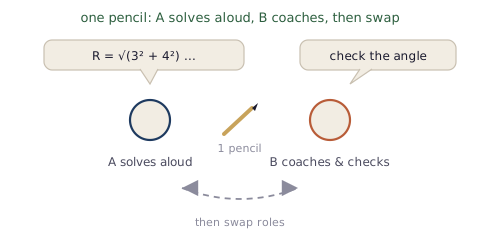
It passes the PIES test:
One pencil and one set per pair; the coach is responsible for catching a slip before the answer is written down.
Each partner solves a full set aloud, and any learner may be called in the whole-class check.
Partners alternate solver and coach for the two sets, so each does both jobs.
Every pair is solving and coaching at the same time.
Three things to prepare
- Print the problem set (below), one per pair, and keep the answers for the check.
- Have rulers, calculators and squared paper to hand, and a formula card showing R = √(a² + b²) and tan θ = opposite ÷ adjacent for support.
- Pair learners so each pair has one pencil. An odd number forms a trio with a coach who rotates each problem.
About 14 minutes, two sets
Decide who is the solver and who is the coach. The solver takes the pencil for Set A; the coach takes the answer card to check against.
The solver works each Set A problem out loud: Pythagoras for the magnitude, then the tangent ratio for the angle. The coach watches, prompts, checks every step and praises what is right.
Hand the pencil over. The other partner now solves Set B aloud while the first coaches, so both partners both solve and coach.
Coaching stems for the coach
The teacher's role during the activity
Circulate and make sure the coach is coaching, not taking the pencil. Listen for the two steps that matter: Pythagoras for the magnitude and the tangent ratio for the angle, and check that every answer carries a direction. Pick one resultant for the whole-class check that follows.
When the room does not behave like the plan
The coach takes over the pencil: remind them their job is to question and check, not to solve.
A pair adds the magnitudes (3 + 4 = 7): point them back to Pythagoras; the resultant is shorter than the two added.
A direction is missing: the answer is not finished until it has both a size and a direction.
Uneven group: a three works as a pair plus a coach who rotates each problem.
- Support: a formula card and a worked three and four example; start each solver on the smaller triples.
- Challenge: ask for the direction as a bearing, or give the resultant and one component and ask for the other.
Find each resultant: magnitude by Pythagoras, angle by the tangent ratio
Give a direction with every answer. The angle is measured from the first force named.
Two perpendicular forces of 6 N and 8 N. Find the resultant: magnitude, and the angle from the 6 N force.
Two perpendicular forces of 5 N and 12 N. Find the resultant: magnitude, and the angle from the 5 N force.
Two perpendicular forces of 8 N and 15 N. Find the resultant: magnitude, and the angle from the 8 N force.
Two perpendicular forces of 3 N and 4 N. Find the resultant: magnitude, and the angle from the 3 N force.
Two perpendicular forces of 7 N and 24 N. Find the resultant: magnitude, and the angle from the 7 N force.
Two perpendicular forces of 20 N and 21 N. Find the resultant: magnitude, and the angle from the 20 N force.
Magnitude by Pythagoras, angle by the tangent ratio
Angles are rounded to the nearest degree and are measured from the first force named.
| Problem | Worked answer |
|---|---|
| A1 | R = √(6² + 8²) = 10 N; tan θ = 8 ÷ 6, θ = 53° |
| A2 | R = √(5² + 12²) = 13 N; tan θ = 12 ÷ 5, θ = 67° |
| A3 | R = √(8² + 15²) = 17 N; tan θ = 15 ÷ 8, θ = 62° |
| B1 | R = √(3² + 4²) = 5 N; tan θ = 4 ÷ 3, θ = 53° |
| B2 | R = √(7² + 24²) = 25 N; tan θ = 24 ÷ 7, θ = 74° |
| B3 | R = √(20² + 21²) = 29 N; tan θ = 21 ÷ 20, θ = 46° |