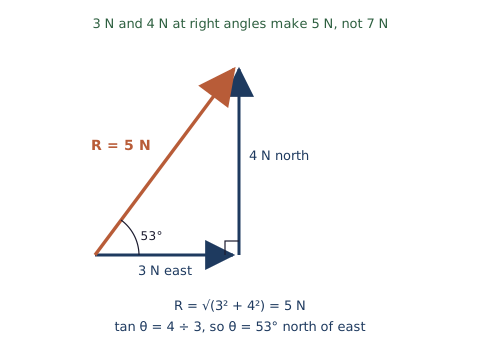
Two perpendicular forces, 3 N and 4 N, act on a point (see the diagram). State the resultant, and explain why it is 5 N and not 7 N.
Two perpendicular forces act on a point: 6 N east and 8 N north.
A swimmer heads due north at 5 m/s. A current carries them due east at 12 m/s.
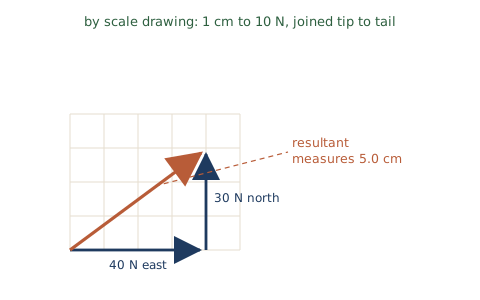
Scale drawing. Two perpendicular forces of 30 N and 40 N act on a point.
A resultant of 13 N is made from two perpendicular components. One component is 5 N. Calculate the other component.
(a) State the two things every resultant answer must include. (b) Give one reason a scale-drawing answer may differ slightly from a calculated one.
Total: 15 marks. Original work by the TheLucidSTEM team. Written in the style of the papers; no past paper question is reproduced.
Answer key · full worked solutionsclick to reveal
Resultant = 5 N. Perpendicular vectors do not add arithmetically: combine with Pythagoras, √(3² + 4²) = 5 N. The resultant also needs a direction, so 3 + 4 = 7 is wrong on both counts.
(a) R = √(6² + 8²) = √100 = 10 N.
(b) tan θ = 8 ÷ 6, so θ = 53° north of east.
(a) resultant = √(5² + 12²) = √169 = 13 m/s.
(b) tan θ = 12 ÷ 5, so θ = 67° east of north.
(a) a suitable scale is 1 cm to 10 N.
(b) 5.0 cm represents 5.0 × 10 = 50 N.
(c) by calculation, R = √(30² + 40²) = √2500 = 50 N, which agrees.
other component = √(13² − 5²) = √(169 − 25) = √144 = 12 N.
(a) a magnitude (size) and a direction.
(b) a scale drawing depends on the accuracy of the ruler and protractor, so it carries measurement error and is only approximate.