The shape of the lesson
By the end of the lesson, learners can
- define speed as the distance travelled per unit time, and use average speed = distance ÷ time (v = s ÷ t)
- define velocity as speed in a given direction
- rearrange and use v = s ÷ t to find s, v or t, with correct units
- convert between km/h and m/s
- recognise that the gradient of a distance-time graph represents speed (a bridge to Lesson 2)
Key vocabulary
speed, velocity, average speed, distance, time, metre per second, kilometre per hour, gradient, direction, uniform motion. Each term is introduced as it is first needed.
One picture, and the tool it carries
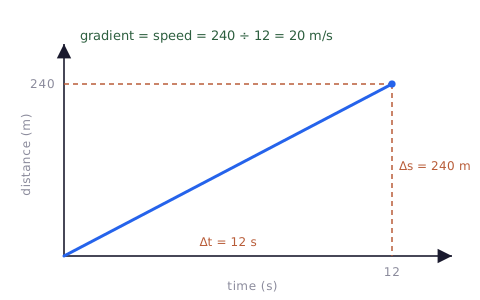
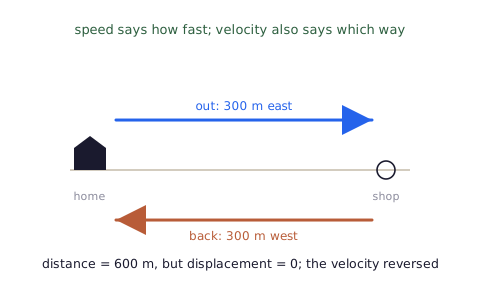
The unit shares one picture, the twin-graph poster: a single journey drawn as both a distance-time graph and a speed-time graph. This lesson introduces it through the distance-time side, where the gradient of the line is the speed. That connects directly to the tool of the lesson, v = s ÷ t. The site simulation The Round Trip Trap feeds the contrast that learners must hold onto: on a journey out and back, distance and average speed grow, but velocity carries a direction and can fall to zero. Speed answers how fast; velocity also answers which way.
Forty-five minutes, phase by phase
| Time | Phase | What happens in the room | Grouping |
|---|---|---|---|
| 0 to 5 min | Hook: the round trip | The site simulation The Round Trip Trap runs on the board. On a journey out and back, the distance and the average speed keep rising, while the velocity points in a direction and reverses. It sets up two questions: what is speed, and how is velocity different? | Whole class, sim on board |
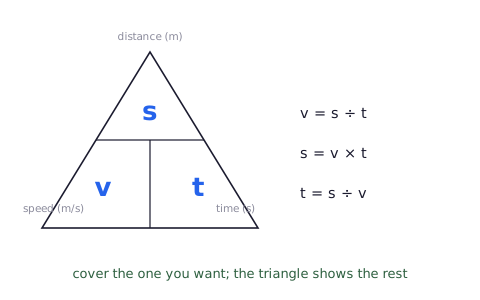
| 5 to 16 min | Build the tools | Speed is defined as distance per unit time, average speed = distance ÷ time (v = s ÷ t), with the unit metre per second. Velocity is speed in a stated direction. The equation triangle rearranges for s, v or t, and km/h is converted to m/s by dividing by 3.6. The distance-time graph is introduced: its gradient is the speed, which previews the twin-graph poster. | Whole class, teacher led |
| 16 to 30 min | Rally Coach | In pairs, partner A solves a speed calculation aloud while partner B coaches and checks; then they swap. The set mixes finding v, s and t with a km/h to m/s conversion. The full step-by-step facilitation, roles and teacher script are in the activity materials in this bundle. | Pairs, Rally Coach |
| 30 to 38 min | Check | Three short speed calculations on mini whiteboards, including one conversion. A number is called and that learner talks the class through one solution. | Individual, then whole class |
| 38 to 45 min | Plenary and exit | Exit ticket: three speed calculations (one a km/h to m/s conversion), and one line on why velocity needs a direction. Learners self assess against the objectives. | Individual |
Protect the practice and the exit
The calculation practice is the heart of the lesson. Keep the build tight so Rally Coach has its full time, and cap the check so the exit is protected.
Protected: the exit ticket. It is the only individual check of the Core outcomes and is not cut.
If time is short: reduce Rally Coach to two rounds and set the conversion practice as the start of the next lesson.
In a 60 minute block: add the average-speed measurement (time a walk over a set distance) and a multi-stage journey, where average speed is total distance ÷ total time, not the mean of the speeds.
Rally Coach, in brief
Learners work in pairs with one pencil and one problem set. Partner A solves the first problem aloud while partner B coaches and checks each step, then they swap roles for the next. The coaching is where dropped units and the wrong conversion are caught early. A full step-by-step facilitation guide, with roles, a teacher script, circulation prompts and troubleshooting, is provided as the Rally Coach activity in this bundle, so the structure can be run faithfully.
Why it suits this lesson. Speed calculations are short and procedural, and easy to get almost right. Rally Coach gives immediate, step-by-step checking from a peer, which is exactly what builds accuracy and fluency.
What to head off, and how
| Trap learners fall into | Teaching move that pre-empts it |
|---|---|
| Giving a velocity with no direction. | Velocity is speed in a stated direction. An answer of 8 m/s is a speed; 8 m/s due east is a velocity. |
| Dropping units, or mixing km, m, hours and seconds. | Write the unit at every step, and convert to consistent units (m and s) before calculating. |
| Averaging two speeds to get the average speed. | Average speed = total distance ÷ total time, not the mean of the speeds. Add the distances, add the times, then divide. |
| Converting km/h and m/s the wrong way. | To go from km/h to m/s, divide by 3.6; from m/s to km/h, multiply by 3.6. The m/s value is always the smaller number. |
| Rearranging v = s ÷ t incorrectly. | Use the equation triangle: s = v × t and t = s ÷ v. Cover the quantity you want to find. |
Support, challenge and the checks
- Support: an equation-triangle card, a conversion helper (divide by 3.6, multiply by 3.6), a worked example, and a partly completed calculation table.
- Challenge: multi-stage journeys where average speed is total distance ÷ total time, combined unit conversions, and reading a speed as the gradient of a distance-time graph.
- Language: rehearse "the speed is ... m/s" and "the velocity is ... m/s due ..." so that a direction is never left off a velocity.
Assessment is formative. Rally Coach gives step-by-step peer checking; the mini-whiteboard check with random call tests an individual calculation; and the exit ticket maps to the Core objectives, three calculations with units.
Equipment and resources
- calculators and mini whiteboards; a tape or trundle wheel and a stopwatch for the optional average-speed measurement
- the Rally Coach activity (with its facilitation guide), the worksheet and the exit ticket from this bundle
- the site simulation The Round Trip Trap (Unit 1 simulations); the student topic page Speed and velocity