One solves, one coaches, then swap
Rally Coach is a paired structure. Partners alternate between two roles: the Solver, who works one problem aloud, and the Coach, who watches, checks each step, praises what is correct, and prompts where it is not. After each problem the partners swap roles.
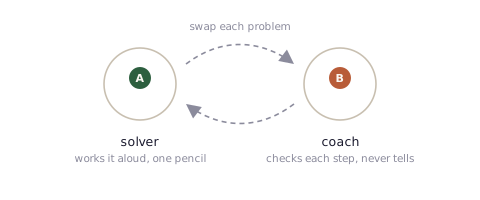
It passes the PIES test:
The pair shares one pencil and one sheet, so they must work together.
Each learner solves their own problems and may be called at random afterwards.
The roles alternate, so airtime is even.
Half the class is actively solving at any moment.
Four things to prepare
- Print one problem set per pair (Set A and Set B are on the same sheet, below).
- Pair learners deliberately. Mixed attainment works well, because the coaching role lets a stronger partner support without taking over the pen.
- Give each pair one pencil only. This enforces turn taking and stops both writing at once.
- Display the equation triangle (v = s ÷ t) and the conversion rule (km/h to m/s: divide by 3.6) on the board.
The roles
Solver
Works the problem aloud, narrating each step: write the formula, substitute the numbers, calculate, then add the unit.
Coach
Follows each step against the answer key, says what is right, and prompts where it is not. The coach does not hold the pen and does not simply give the answer.
About 14 minutes
A is the first Solver; B is the first Coach. Only the Solver holds the pencil.
A solves A1 aloud. B coaches with the prompts below, then praises one specific thing A did well.
B becomes the Solver for B1; A coaches. Pass the one pencil across.
Continue through problems 2 and 3, swapping each time, so each partner solves three and coaches three.
Pairs compare their answers with the key, fix any that are wrong, and write a one-line note on what went wrong.
What the coach says
Give learners these sentence stems. The coach prompts; the coach never just states the answer.
The teacher's role during the activity
Circulate and listen for the usual errors: dropped units, the conversion done the wrong way, and averaging two speeds instead of using total distance ÷ total time. Do not solve for learners; ask the coach what they think. Note two or three errors to surface in a 30 second mini-plenary.
Closing the activity
After the rounds, use random call: name a learner and a problem number, and ask them to explain the method, not just the answer. Because anyone may be called, every learner stays accountable for understanding each step. This feeds straight into the lesson's exit ticket.
When the room does not behave like the plan
One partner dominates: remind the pair that only the Solver writes and speaks, and the Coach's job is to ask, not tell.
Both are stuck: the coach reads the worked example on the board; if still stuck, raise a hand and the teacher prompts rather than solves.
A pair finishes early: give a challenge, a multi-stage journey where average speed is total distance ÷ total time, or have them write their own problem with a worked answer.
Odd number of learners: form one trio with two coaches who alternate.
- Support: provide the equation triangle on the sheet and pre-converted units, and reduce to two rounds.
- Challenge: add a convert-then-calculate problem, where the units must be changed before the numbers are substituted.
One sheet per pair
Partner A solves Set A aloud while B coaches, then swap for Set B. Show the formula, substitute, calculate, and give the unit.
- A car travels 150 m in 6 s. Find the speed.
- A runner moves at 4 m/s for 30 s. Find the distance.
- Change 90 km/h into m/s.
- A train travels 800 m in 40 s. Find the speed.
- A cyclist rides at 8 m/s and covers 200 m. Find the time.
- Change 36 km/h into m/s.
For the coach to check against
| Problem | Worked answer |
|---|---|
| A1 | v = s ÷ t = 150 ÷ 6 = 25 m/s |
| A2 | s = v × t = 4 × 30 = 120 m |
| A3 | 90 ÷ 3.6 = 25 m/s |
| B1 | v = s ÷ t = 800 ÷ 40 = 20 m/s |
| B2 | t = s ÷ v = 200 ÷ 8 = 25 s |
| B3 | 36 ÷ 3.6 = 10 m/s |