Define (a) speed and (b) velocity.
A car travels 240 m in 12 s at a steady rate. (a) Calculate its speed. (b) State its velocity if it travels due east.
(a) Change 72 km/h to m/s. (b) Change 15 m/s to km/h. (c) Which is faster: 90 km/h or 23 m/s?
A runner covers 600 m in 30 s, then a further 600 m in 60 s. (a) State the total distance. (b) State the total time. (c) Calculate the average speed for the whole run.
A train moves at a steady 30 m/s for 45 s. Calculate the distance it travels.
(a) Explain the difference between speed and velocity. (b) A car goes around a roundabout at a steady speed. Explain why its velocity is still changing.
Total: 15 marks. Original work by the TheLucidSTEM team. Written in the style of the papers; no past paper question is reproduced.
Answer key · full worked solutionsclick to reveal
(a) speed is the distance travelled per unit time (a scalar).
(b) velocity is speed in a stated direction (a vector).
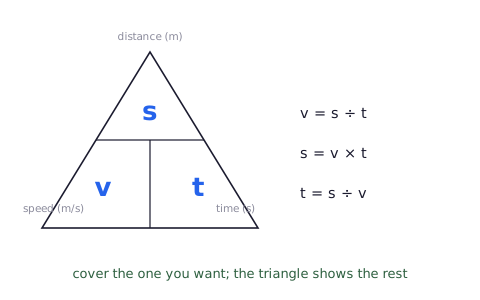
(a) v = s ÷ t = 240 ÷ 12 = 20 m/s.
(b) velocity = 20 m/s due east.
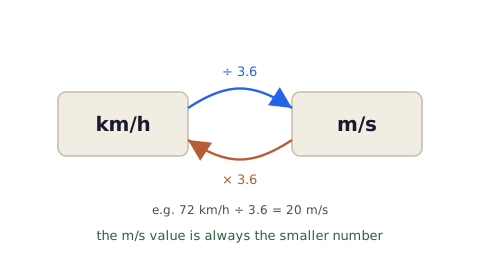
(a) 72 ÷ 3.6 = 20 m/s.
(b) 15 × 3.6 = 54 km/h.
(c) 90 km/h = 90 ÷ 3.6 = 25 m/s, which is greater than 23 m/s, so 90 km/h is faster.
(a) total distance = 600 + 600 = 1200 m.
(b) total time = 30 + 60 = 90 s.
(c) average speed = total distance ÷ total time = 1200 ÷ 90 = 13.3 m/s (not the mean of the two speeds, which would be 15 m/s).
s = v × t = 30 × 45 = 1350 m.
(a) speed is how fast only (a scalar); velocity is speed with a direction (a vector).
(b) on a roundabout the direction of travel keeps changing, so the velocity changes even though the speed is steady.