The shape of the lesson
By the end of the lesson, learners can
- read a speed-time graph and state when an object is at rest, at constant speed, accelerating or decelerating
- sketch a speed-time graph for a described journey
- define acceleration as the change in velocity per unit time, and recall and use a = Δv ÷ Δt
- give the unit of acceleration as m/s²
- tell a speed-time graph from a distance-time graph by reading the axes first
- determine an acceleration from the gradient of a speed-time graph
- determine the distance travelled from the area under a speed-time graph, and treat a deceleration as a negative acceleration
Key vocabulary
speed-time graph, acceleration, deceleration, constant speed, at rest, gradient, area under a graph, metre per second squared, change in velocity. Each term is introduced as it is first needed.
One picture the whole unit shares
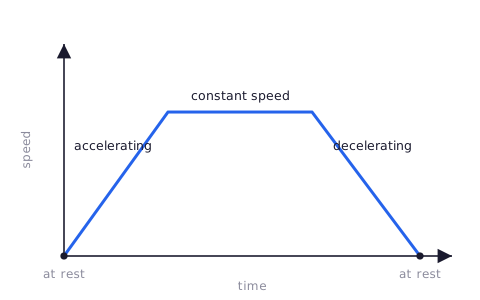
The unit shares one picture, the twin-graph poster, and this lesson builds its speed-time side. One journey is drawn as speed against time: on the time axis it is at rest, a horizontal line above the axis is constant speed, a line sloping up is accelerating, and a line sloping down is decelerating. Acceleration is the change in velocity per unit time, a = Δv ÷ Δt, measured in m/s². The simulation Acceleration from a Velocity-Time Line lets learners shape the line and see that a steeper line is a greater acceleration. For Extended learners the same picture gives more: the gradient is the acceleration and the area under the line is the distance.
Forty-five minutes, phase by phase
| Time | Phase | What happens in the room | Grouping |
|---|---|---|---|
| 0 to 5 min | Hook: shape the line | The site simulation Acceleration from a Velocity-Time Line runs on the board. Learners shape the line to a target gradient and run it: a steeper line is a greater acceleration, a flat line is constant speed, and a downward line is slowing down. The question: what does the slope of a speed-time line tell us? | Whole class, sim on board |
| 5 to 16 min | Build the reading | The speed-time side of the poster is built: a line on the time axis is at rest, a horizontal line above it is constant speed, a line sloping up is accelerating, and a line sloping down is decelerating. Acceleration is defined as the change in velocity per unit time, a = Δv ÷ Δt, with the unit m/s². Extended: the gradient is the acceleration and the area is the distance. | Whole class, teacher led |
| 16 to 30 min | Jigsaw | Each learner becomes the expert on one feature (constant speed, acceleration, deceleration, or area), meets the other experts, then returns to teach their home group, so the group assembles all four. The full facilitation, with expert cards, a teacher script and the answer key, is in the activity materials in this bundle. | Home and expert groups |
| 30 to 38 min | Check | On mini whiteboards, learners label the features of a given speed-time graph and find one acceleration with a = Δv ÷ Δt. A number is called and that learner explains. | Individual, then whole class |
| 38 to 45 min | Plenary and exit | Exit ticket: sketch and label a short speed-time journey, find one acceleration, and state what a horizontal line means on a speed-time graph. Learners self assess against the objectives. | Individual |
Protect the parts that carry the learning
The Jigsaw needs its full time to work, because each learner must both learn and teach. Keep the build tight and protect the exit.
Protected: the exit ticket. It is the only individual check of the Core outcomes and is not cut.
If time is short: run the Jigsaw with three features (constant speed, acceleration, deceleration) and set the area feature as the start of Lesson 5.
In a 60 minute block: build a speed-time graph from a ramp and light gates, and for Extended learners find the acceleration from the gradient and the distance from the area.
Jigsaw, in brief
Each learner is assigned one of four features of a speed-time graph: constant speed, acceleration, deceleration, or area. The experts on each feature meet to master it, then return to their home group and teach it, so the group ends with all four. Because each learner is the only source of their feature, every learner must both learn and explain. A full step-by-step facilitation guide, with the expert cards, sentence stems, a teacher script and the answer key, is provided as the activity in this bundle, so the structure can be run faithfully.
Why it suits this lesson. A speed-time graph has several distinct features that are best learned by teaching one to others. The Jigsaw gives every learner a clear, accountable role and assembles the whole picture from the parts.
What to head off, and how
| Trap learners fall into | Teaching move that pre-empts it |
|---|---|
| Confusing a speed-time graph with a distance-time graph. | On a speed-time graph a horizontal line is constant speed; on a distance-time graph it is stationary. Read the axes first, every time. |
| Reading at rest from a horizontal line. | An object is at rest only where the speed-time line is on the time axis, speed zero, not where the line is horizontal above it. |
| Thinking a downward slope means moving backwards. | A downward slope on a speed-time graph means slowing down: the speed is falling. Direction is not shown by a speed-time graph. |
| Giving acceleration in m/s. | Acceleration is a change in speed each second, so its unit is m/s², not m/s. |
| Extended: missing the gradient and the area. | On a speed-time graph the gradient is the acceleration and the area under the line is the distance travelled. |
Support, challenge and the checks
- Support: a feature word bank (at rest, constant speed, speeding up, slowing down), pre-drawn axes, and a worked acceleration calculation.
- Challenge (Extended): find the acceleration from the gradient with a large triangle, and the distance from the area split into a triangle and a rectangle.
- Language: rehearse "a horizontal line means constant speed" and "the acceleration is ... m/s²" so the readings and the unit are stated precisely.
Assessment is formative. The Jigsaw makes every learner teach a feature; the mini-whiteboard check with random call tests an individual; and the exit ticket maps to the Core outcomes, labelling a graph and using a = Δv ÷ Δt.
Equipment and resources
- mini whiteboards, and (for the optional practical) a ramp, a trolley or ball, and light gates or an electronic timer
- the Jigsaw activity (with its facilitation guide), the worksheet and the exit ticket from this bundle
- the site simulation Acceleration from a Velocity-Time Line (Unit 1 simulations); the student topic pages Acceleration and Motion graphs