On a speed-time graph, state what each of these shows: (a) a horizontal line above the time axis; (b) a line that slopes upwards.
Define acceleration and give its unit.
A car speeds up from rest to 24 m/s in 6 s.
(a) Calculate its acceleration. (b) The car then holds a steady 24 m/s. What does the speed-time line look like during this time?
The speed-time graph below shows a journey.
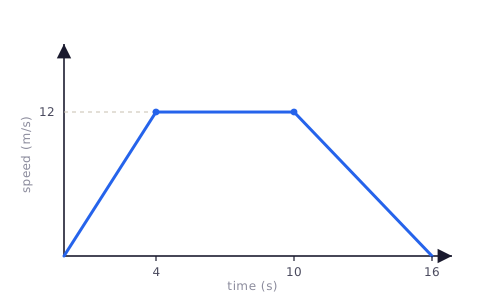
(a) Describe the motion between 4 s and 10 s. (b) Calculate the acceleration during the first 4 s. (c) At which times is the object at rest?
On a speed-time graph, what does a horizontal line mean? Explain how this differs from a horizontal line on a distance-time graph.
ExtendedA cyclist slows steadily from 15 m/s to 3 m/s in 4 s. Calculate the deceleration.
Total: 15 marks. Original work by the TheLucidSTEM team. Written in the style of the papers; no past paper question is reproduced.
Answer key · full worked solutionsclick to reveal
(a) a horizontal line above the time axis means a constant speed.
(b) a line sloping upwards means the object is accelerating (speeding up).
acceleration is the change in velocity per unit time. Its unit is m/s².
(a) a = Δv ÷ Δt = 24 ÷ 6 = 4 m/s².
(b) the line is horizontal (flat) at a height of 24 m/s: constant speed.
(a) between 4 s and 10 s the line is horizontal at 12 m/s: constant speed.
(b) a = Δv ÷ Δt = 12 ÷ 4 = 3 m/s².
(c) at rest only at 0 s and at 16 s, where the speed is zero. Between these the object is always moving.
on a speed-time graph a horizontal line means a constant speed. On a distance-time graph a horizontal line means the object is stationary. Read the axes first.
a = Δv ÷ Δt = (3 − 15) ÷ 4 = −3 m/s², so the deceleration is 3 m/s².