Predict, observe, then explain
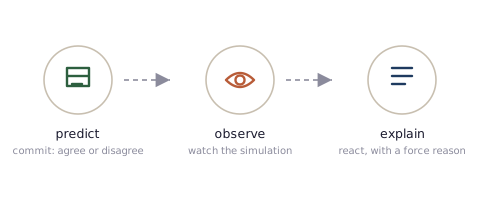
An Anticipation / Reaction Guide is a short list of statements that learners rate as agree or disagree twice: once before the lesson (the anticipation, or prediction) and once after (the reaction, or explanation). Run with a simulation in between, it is exactly the Predict-Observe-Explain cycle: predict by committing to the statements, observe by watching The Skydiver Force Balance, explain by revisiting each statement with a force reason.
It passes the PIES test:
Pairs must agree a shared reaction and reason.
Each learner commits in writing in the anticipation column, and may be asked to justify a reaction.
Both partners give a prediction and a reason.
All learners predict, then all react, at once.
Three things to prepare
- Print the statement sheet (below), one per learner.
- Have The Skydiver Force Balance ready on the board.
- Arrange learners in pairs, grouped into fours for the final compare.
About 24 minutes, in three phases
Each learner reads the six statements and ticks agree or disagree in the anticipation column. No discussion yet, and no right answers given.
Partners compare their predictions and note where they disagree. They do not change their answers yet; disagreement is useful.
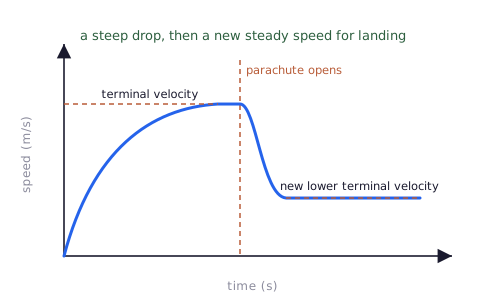
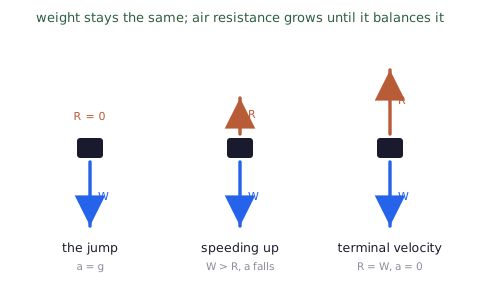
Run The Skydiver Force Balance on the board. Direct attention to the two arrows (weight and air resistance) and to the speed-time line. Ask learners to watch for the moment the arrows become equal and the line flattens. They jot what they see, not what they expected.
Pairs return to the six statements and complete the reaction column: agree or disagree now, each with a one-line force reason.
The two pairs compare reactions and reasons, and reconcile any difference.
Pairs predict, then reason, what happens when the parachute opens, using the same force language.
Sentence stems for the reaction
The teacher's role during the activity
During the prediction, keep it silent and individual first; the value is in the private commitment. During the reaction, circulate and listen for the key sentence, that a zero resultant force means a constant velocity, not a stop. Pick one or two reactions to share with the class.
When the room does not behave like the plan
A pair just copies the "right" answers without a reason: the reason is the assessment; ask them to say why in force terms.
A learner will not commit a prediction: tell them a wrong prediction is fine and useful, and is never marked.
"Balanced means stopped" keeps returning: draw the equal arrows and the flat (but high) speed-time line side by side.
Uneven group: a three works as a pair plus one who reads the statements aloud and records.
- Support: give the force diagram for each stage alongside the statements, so the reaction reasons can be read from the arrows.
- Challenge: ask for the second speed-time graph for the parachute case, and for why a heavier skydiver reaches a higher terminal velocity.
Skydiver: agree or disagree?
Tick agree or disagree before the lesson (anticipation), then again after (reaction). In the reaction, add a one-line reason in force terms.
| # | Statement | Anticipation | Reaction |
|---|---|---|---|
| 1 | The moment the skydiver jumps, the air resistance on them is zero. | A / D | A / D |
| 2 | As the skydiver speeds up, the air resistance gets bigger. | A / D | A / D |
| 3 | The skydiver keeps speeding up at the same rate all the way down. | A / D | A / D |
| 4 | At terminal velocity, the resultant force on the skydiver is zero. | A / D | A / D |
| 5 | At terminal velocity, the skydiver has stopped moving. | A / D | A / D |
| 6 | When the parachute opens, the skydiver speeds up. | A / D | A / D |
Reaction reason (one line each): write why, in force terms, on the back or in your book.
Reactions, with reasons
| # | Reaction | Reason, in force terms |
|---|---|---|
| 1 | Agree | At the jump the speed is zero, so there is no air resistance yet; only the weight acts. |
| 2 | Agree | Air resistance grows as the object moves faster through the air. |
| 3 | Disagree | The acceleration is largest at the start and gets smaller as the air resistance grows; the rate of speeding up falls. |
| 4 | Agree | At terminal velocity the air resistance has grown until it equals the weight, so the resultant force is zero. |
| 5 | Disagree | A zero resultant force means no acceleration, so a constant velocity: the skydiver is still moving, at the fastest steady speed. |
| 6 | Disagree | Opening the parachute makes the air resistance larger than the weight, so the resultant is upward and the skydiver slows down, to a new lower terminal velocity. |
The new, lower terminal velocity
When the parachute opens, the area is much larger, so the air resistance suddenly becomes much bigger than the weight. The resultant force now acts upward, so the skydiver decelerates. As the speed falls the air resistance falls, until it equals the weight again, and the skydiver settles at a new, lower terminal velocity for a safe landing.