Commit with your feet, then defend it
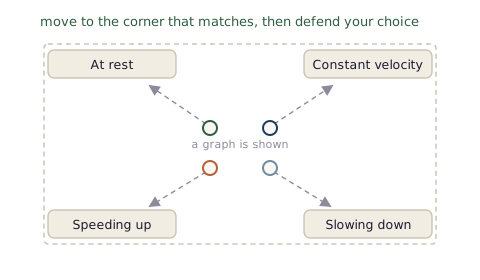
The four corners of the room are labelled at rest, constant velocity, speeding up and slowing down. The teacher shows a graph or reads a motion, and each learner physically moves to the corner they believe matches. Same-corner learners build the strongest reason for their choice; corners then challenge each other, and a learner may switch corner if convinced. Choosing a corner is a public commitment, so no learner can stay undecided.
It passes the PIES test:
Same-corner learners must build one shared reason to defend against the other corners.
Choosing a corner is a public commitment, and each learner must be ready to justify it.
Every learner moves and commits on every round, not just the confident few.
The whole class commits and discusses at once, corner by corner.
Label the four corners
Print these large, one per corner of the room.
About twenty minutes
Show the graph or read the motion for the round.
Each learner moves to the corner they believe matches; the move is the commitment.
Same-corner learners take a moment to agree their best reason for the choice.
Take one reason from two corners; learners may switch if convinced. Confirm the answer, then run the next round.
Watch the trap. The same shape means different motion on the two graph types. A straight upward line is constant velocity on a displacement-time graph, but speeding up on a velocity-time graph. Always have learners name the axes before they commit.
Seven graphs to place
Teacher answer keyclick to reveal
on a velocity-time graph a horizontal line means the velocity is not changing.
on a displacement-time graph a constant gradient means a constant velocity.
on a velocity-time graph a rising line means the velocity is increasing, so the object accelerates.
on a velocity-time graph a falling line means the velocity is decreasing.
on a displacement-time graph a horizontal line means the displacement is not changing.
on a displacement-time graph an increasing gradient means the velocity is increasing.
on a displacement-time graph a decreasing gradient means the velocity is falling toward zero (the object is coming to rest).
When the room does not behave like the plan
Everyone goes to the same corner: good; ask them to predict what graph would justify each of the other corners.
A learner will not commit: the move is the point; a tentative choice they can defend beats standing in the middle.
The room is too small to move: use four labelled cards held up, or four columns of seats, instead of physical corners.
A round splits the class: that is the best round to slow down on; have each corner name the axes before reasoning.
- Support: give a paired set of motion descriptions and graph sketches to match before the rounds begin.
- Challenge: ask a corner to sketch the velocity-time graph that matches a given displacement-time curve.