Commit a belief, then revisit it
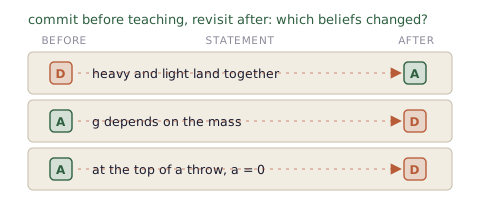
An Anticipation and Reaction Guide is a short list of statements that learners rate as agree or disagree twice: once before the lesson, working alone, and once after. Between the two they are taught the content, so the second pass makes them confront any belief that has changed. Each learner keeps a personal before-and-after record and has to explain what shifted.
It passes the PIES test:
Pairs compare their before-and-after records, so each relies on the other to test and defend a reason.
Every learner records and must justify their own before and after answers, alone.
Each learner commits to every statement twice, so no one opts out of forming a view.
The whole class marks the guide at once, before and after, then compares in pairs.
Before and after the teaching
Before any teaching, each learner writes A (agree) or D (disagree) in the Before column for every statement, with no discussion.
Teach the free-fall lesson as planned; learners keep their guide aside.
Learners return to the guide, fill in the After column, and write what changed and why for any statement that shifted.
Pairs compare before and after; the teacher collects the statements that changed the most minds for the plenary.
Free fall: agree or disagree?
Write A (agree) or D (disagree) in each column. Assume no air resistance unless the statement says otherwise.
| # | Statement | Before | After |
|---|---|---|---|
| 1 | A heavy ball and a light ball dropped together from the same height land at the same time. | · | · |
| 2 | At the highest point of its flight, a ball thrown straight up has zero acceleration. | · | · |
| 3 | A falling object with no air resistance speeds up at a steady rate. | · | · |
| 4 | With air resistance present, a heavier object can reach the ground first. | · | · |
| 5 | The acceleration of free fall depends on the mass of the object. | · | · |
| 6 | A ball thrown up at 20 m per second returns to its start with a speed of 20 m per second. | · | · |
Teacher answer keyclick to reveal
without air resistance the acceleration is g for both, so they fall together regardless of mass.
the velocity is zero at the top, but the acceleration is still g downward; the ball is still accelerating.
with no air resistance the acceleration is constant at g, so the speed increases at a steady rate.
air resistance has a relatively smaller effect on a denser or heavier object, so it can reach the ground first (for example a hammer and a feather in air).
the acceleration of free fall is the same for all masses; it does not depend on mass.
with no air resistance the motion is symmetric, so the ball returns to its start with the same speed it was thrown.
When the room does not behave like the plan
Learners discuss during the Before pass: the first pass is silent and individual; the value is in committing a private belief.
A learner's answer does not change: that is fine if they can justify it; ask for the reason in physics terms.
No statements changed any minds: probe the reasons; some learners hold the right answer for the wrong reason.
Short on time: the After pass and the pair compare are the heart of it; protect those over a long plenary.
- Support: give a force or motion diagram beside each statement so the After reasons can be read from it.
- Challenge: ask learners to write one new statement that would catch a classmate out, with its answer and reason.