The shape of the lesson
By the end of the lesson, learners can
- state that g is the acceleration of free fall, about 9.81 m s−2 near the Earth's surface, directed downward
- state that, with no air resistance, all objects fall with the same acceleration regardless of mass
- apply the equations of motion to vertical motion under gravity using a consistent sign convention
- solve problems on dropped objects and objects projected vertically, including maximum height and time of flight
- describe an experiment to determine g
- describe qualitatively the effect of air resistance on a falling object
Key vocabulary
free fall, acceleration of free fall g, mass independence, sign convention, maximum height, time of flight, air resistance, terminal velocity. Each term is introduced as it is first needed.
Same g for every mass
Free fall is motion under gravity alone. The acceleration is g, about 9.81 m s−2 downward, and it does not depend on mass, so a heavy and a light object released together fall at the same rate. A freely falling object still has weight; that weight is exactly what produces the acceleration g.
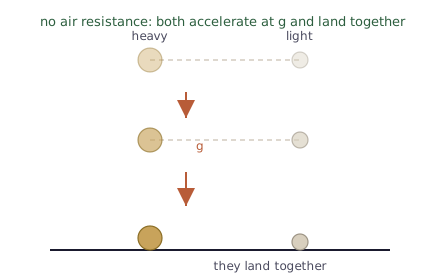
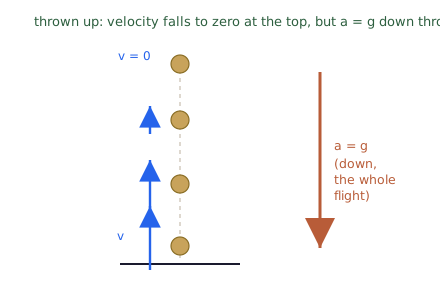
Vertical motion is solved with the suvat equations using a = g. Choose one positive direction, up or down, and keep it for u, v, a and s throughout. At the highest point of an upward throw the velocity is zero for an instant, but the acceleration is still g downward, so the ball is still accelerating.
Determining g, and air resistance
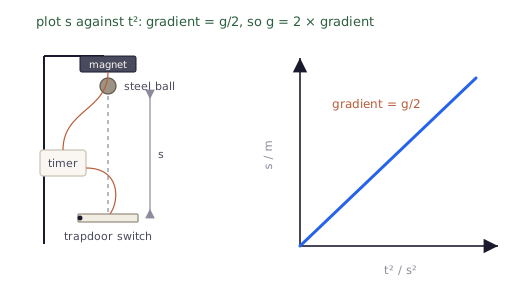
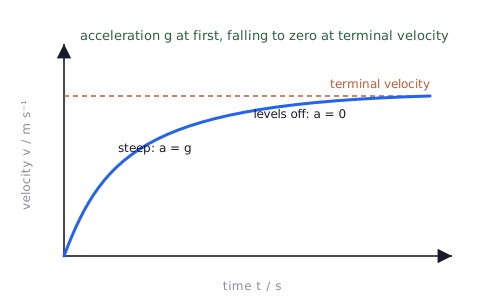
g can be measured by timing a ball dropped through a measured height and plotting s against t squared; the gradient is g / 2. With air resistance, the resultant downward force falls as the speed rises, the acceleration decreases, and the object may approach a terminal velocity.
Sixty minutes, phase by phase
| Time | Phase | What happens in the room | Resources |
|---|---|---|---|
| 0 to 8 min | Starter | Hand out the Anticipation and Reaction guide; learners mark agree or disagree for each statement before any teaching, working alone. | Anticipation guide (Before) |
| 8 to 23 min | Teach: g and signs | Establish g, mass independence and the sign convention; model vertical suvat for a drop and an upward throw. | Slides 1 to 6, fig-free-fall-equal, fig-up-throw |
| 23 to 35 min | Teach: determining g | Describe the electromagnet-and-trapdoor experiment and the s against t squared graph. | Slides 7 to 9, fig-determine-g |
| 35 to 42 min | Teach: air resistance | Describe air resistance qualitatively and the approach to terminal velocity; learners sketch the v-t graph with drag. | Slide 10, fig-air-resistance |
| 42 to 50 min | Activity | Learners complete the After column of the guide, correcting their thinking, and note what changed. | Anticipation guide (After) |
| 50 to 60 min | Plenary | Exit ticket, then discuss the statement that changed the most minds. | Exit ticket slide |
A drop and an upward throw
Example 1: a drop
A stone is dropped from rest from a height of 45 m. Taking down as positive and g = 9.81 m s−2, find the time to reach the ground and the speed on impact.
Example 2: an upward throw
A ball is thrown straight up at 20 m s−1. Taking up as positive and g = 9.81 m s−2, find the maximum height and the total time of flight back to the start.
Anticipation and Reaction Guide
Before any teaching, learners mark agree or disagree for each of six free-fall statements, working alone. After the lesson they revisit the same statements, mark them again, and write what changed and why. Pairs then compare their before-and-after answers, and the teacher collects the statements that shifted the most opinion. A full step-by-step facilitation guide, with the statement sheet and a teacher answer key, is provided as the activity in this bundle, so it can be run faithfully, including by a cover teacher.

Why it suits this lesson. Free fall is full of strong, sticky misconceptions, so it helps to surface each learner's starting belief and then make the shift visible. Every learner owns a personal before-and-after record and has to explain any change, which keeps each accountable for their own thinking.
What to head off, and how
| Trap learners fall into | Teaching move that pre-empts it |
|---|---|
| Believing heavier objects fall faster. | Without air resistance the rate of fall is the same for all masses, because g does not depend on mass. |
| Saying the acceleration is zero at the top of a throw. | The velocity is zero there for an instant, but the acceleration is still g downward. |
| Treating free fall as weightless or force-free. | A freely falling object still has weight; that weight is exactly what produces the acceleration g. |
| Assuming air resistance is always negligible. | For light or large-area objects it matters, reduces the acceleration, and leads to a terminal velocity. |
Support, challenge and the checks
- Support: a signs frame that fixes the positive direction and the values of u, a and s before any calculation.
- Challenge: solve for an object thrown up from a cliff that then falls past the launch point, and sketch its velocity-time graph including air resistance.
- Language: rehearse the frames "taking down as positive, a = ..." and "at the top, v is ... but a is ..." before learners write.
Assessment is formative. Exit ticket question 1: a ball is dropped from 20 m, find the time to reach the ground and the impact speed (g = 9.81 m s−2). Exit ticket question 2: at the highest point of a vertical throw, state the velocity and the acceleration of the ball. Each learner's before-and-after record makes the change in thinking visible.
Equipment and resources
- the Anticipation and Reaction statement sheet, and the worksheet from this bundle
- a signs frame for support, and the exit ticket from the final slide
- the site simulation Free Fall and the Equations of Motion, and the student topic page Equations of motion