Make the connections explicit
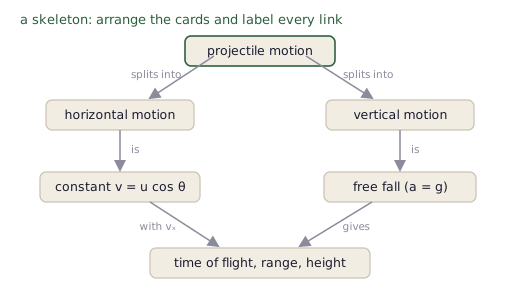
In Cooperative Concept Mapping each group is given a set of concept cards and a large sheet. They arrange the cards and join them with labelled arrows that state the relationship, for example splits into, is, determines or gives. Projectile motion is where vectors, the equations of motion and free fall all come together, so it is an ideal point to map how the ideas connect, and to expose where a learner's connections are missing.
It passes the PIES test:
The group shares one map and one set of cards, so the map only works if the links agree.
Every learner must justify aloud at least one link they drew; gaps reveal who needs support.
Cards are shared out so each learner places and links some, not just the confident few.
Every group builds at once, and the comparison at the end has all maps in play together.
Build, justify, compare
Give each group the concept card set and a large sheet; they may add their own cards if a link needs one.
Groups place the cards and join them with arrows, each labelled with the relationship (splits into, is, determines, gives).
Every learner justifies aloud at least one link they drew; the group checks it makes sense in physics.
Groups compare maps and refine; the teacher adds air resistance as a final node and asks what it changes.
Print and cut
Fifteen cards. The first is the hub; learners arrange the rest around it and label every link.
Teacher model map · key linksclick to reveal
A strong map should include links close to these. Wording will vary; look for correct relationships and justifications.
- projectile motion splits into horizontal motion and vertical motion (independence of the two motions).
- horizontal motion has constant horizontal velocity, equal to u cos θ.
- vertical motion is vertical free fall (a = g).
- launch velocity u and launch angle θ give the horizontal component u cos θ and the vertical component u sin θ.
- vertical motion determines the time of flight and the maximum height.
- time of flight together with the constant horizontal velocity gives the range.
- the horizontal component and the vertical component (at an instant) combine to give the resultant velocity.
- air resistance reduces the range and the maximum height and makes the path asymmetric (a steeper descent).
When the room does not behave like the plan
A group makes one long chain: a concept map is a network, not a list; prompt for cross-links such as the components combining to the resultant.
Arrows are unlabelled: an unlabelled arrow is not a claim; insist every link names the relationship.
A learner stays silent: hand them a card and ask which card it connects to and why; that is their justified link.
Short on time: the build and the justification are the heart of it; protect those over a long comparison.
- Support: pre-place the hub card and the two motion cards so the group starts from the main split.
- Challenge: ask the group to add a card and link of their own, such as "speed on landing", and justify where it belongs.