The shape of the lesson
By the end of the lesson, learners can
- distinguish scalar and vector quantities and give examples of each
- add and subtract coplanar vectors using a scale diagram (tip to tail or parallelogram)
- resolve a vector into two perpendicular components using F cos θ and F sin θ
- find the magnitude and direction of a resultant using Pythagoras and the tangent ratio
- combine two or more vectors by the component method
- explain that two vectors of fixed size give a resultant whose size depends on the angle between them
Key vocabulary
scalar, vector, magnitude, direction, resultant, component, resolve, tip to tail, parallelogram, coplanar. Each term is introduced as it is first needed.
Sort, add, resolve, recombine
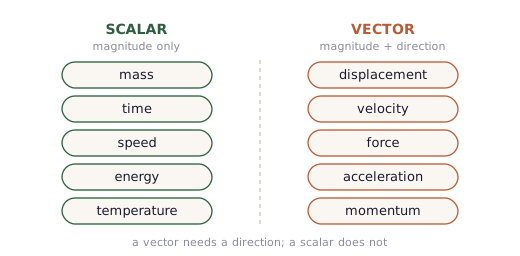
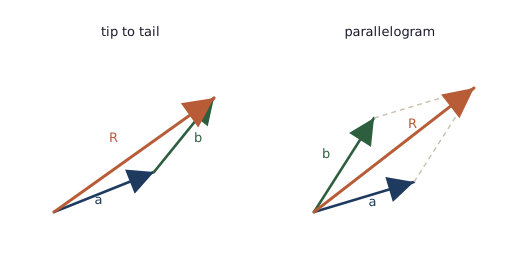
A scalar has magnitude only; a vector has magnitude and direction, and that direction is what makes the arithmetic different. Vectors are added tip to tail or by the parallelogram, and any vector can be split into two perpendicular components that are far easier to handle.
Resolve, then recombine
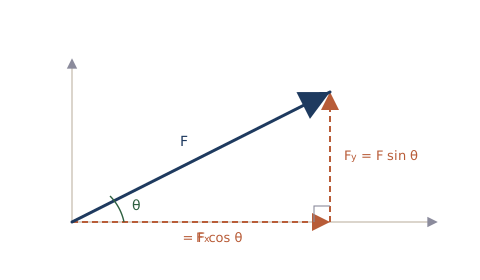
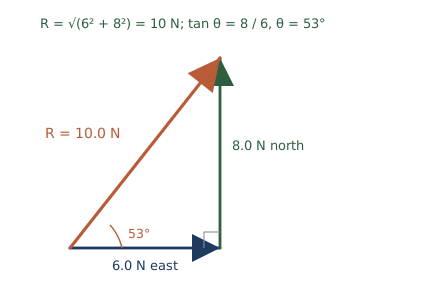
Resolving turns one awkward vector into a horizontal and a vertical component, F cos θ and F sin θ. To find a resultant of perpendicular vectors, recombine with Pythagoras for the magnitude and the tangent ratio for the direction, always stated relative to a named axis.
Sixty minutes, phase by phase
| Time | Phase | What happens in the room | Resources |
|---|---|---|---|
| 0 to 5 min | Starter | A list of quantities to sort into scalar and vector; learners defend two borderline cases. | Slide 1, fig-scalar-vector |
| 5 to 17 min | Teach: adding | Define scalar and vector; demonstrate adding tip to tail and by the parallelogram. Learners draw a tip-to-tail sum to scale and read off the resultant. | Slides 2 to 5, fig-resultant-parallelogram |
| 17 to 30 min | Teach: resolving | Resolve a vector into perpendicular components; find a resultant by Pythagoras and tangent. Learners resolve a worked vector and check. | Slides 6 to 10, fig-resolve-components, fig-perpendicular-resultant |
| 30 to 50 min | Activity | Think-Pair-Share across three prompts: think alone, compare in pairs, then cold-call pairs to share. | Think-Pair-Share activity sheet |
| 50 to 60 min | Plenary | Exit ticket, then review the prompt that split opinion most. | Exit ticket slide |
Resolving and a resultant
Example 1: resolving
A force of 12 N acts at 35 degrees above the horizontal. Find its horizontal and vertical components.
Example 2: a resultant
Two perpendicular forces act at a point: 6.0 N to the east and 8.0 N to the north. Find the resultant.
Finding a resultant by components
- resolve every vector into horizontal (x) and vertical (y) components
- add all the x components to get the total x; add all the y components to get the total y
- magnitude of the resultant = √(total x2 + total y2)
- direction from tan θ = total y / total x, stated relative to a named axis
Think-Pair-Share
The teacher poses a prompt, ideally one that exposes a misconception. Each learner thinks alone and jots a brief answer in silence, then pairs compare reasoning and agree a shared answer. The teacher then cold-calls pairs to share, and the disagreement is resolved as a class. A full step-by-step facilitation guide, with the three prompts and the teacher notes and answers, is provided as the activity in this bundle, so it can be run faithfully, including by a cover teacher.
Why it suits this lesson. Vector reasoning hides several misconceptions, so it helps to make each learner commit to a view before discussing. The silent think gives individual accountability, and the cold-call after pairing means any pair may be asked to justify their answer.
What to head off, and how
| Trap learners fall into | Teaching move that pre-empts it |
|---|---|
| Believing the resultant of two forces is always their sum. | The numerical sum only applies when they act in the same direction. The resultant depends on the angle between them, from the difference up to the sum. |
| Swapping sine and cosine when resolving. | The component along the reference direction uses cosine of the angle to that direction. Draw the triangle and label it before substituting. |
| Adding the magnitudes of perpendicular vectors directly. | Perpendicular vectors combine by Pythagoras, not by adding magnitudes. 6 and 8 give 10, not 14. |
| Giving a vector answer with no direction. | Every vector answer needs a magnitude and a direction: a bearing, or an angle to a stated axis. |
Support, challenge and the checks
- Support: a labelled right-angled triangle template and a sine, cosine, tangent prompt for each step.
- Challenge: combine two non-perpendicular vectors by components, and find the single force needed to hold an object in equilibrium.
- Language: rehearse the frames "the component along ... is F cos ..." and "the resultant is ... at ... to ..." before learners write.
Assessment is formative. Exit ticket question 1: a force of 20 N acts at 60 degrees to the horizontal, find its horizontal and vertical components. Exit ticket question 2: a swimmer heads north at 1.2 m s−1 across a river flowing east at 0.5 m s−1, find the magnitude of the resultant velocity. Cold-call after pairing gives a quick read on individual reasoning.
Equipment and resources
- the Think-Pair-Share prompts and the worksheet from this bundle
- a right-angled triangle template for support, and the exit ticket from the final slide
- the site simulation Adding and Resolving Vectors, and the student topic page Scalars and vectors