The shape of the lesson
By the end of the lesson, learners can
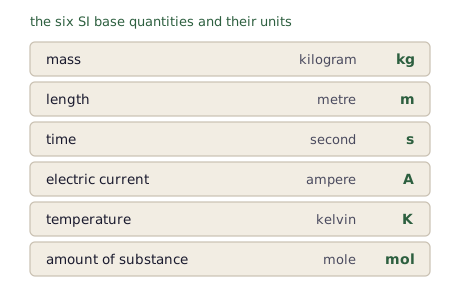
- recall the six SI base quantities and their units (mass, length, time, current, temperature, amount of substance)
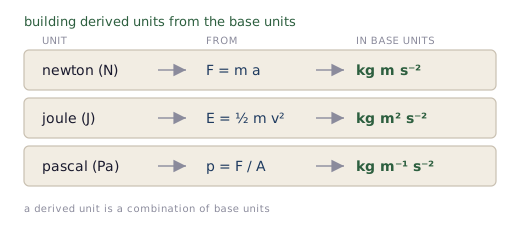
- express derived units in terms of SI base units (for example the newton, joule, pascal and volt)
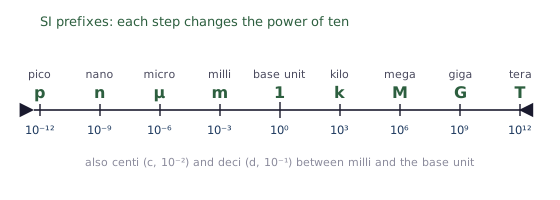
- use the SI prefixes from pico to tera and convert between them
- test whether a physical equation is homogeneous by comparing the base units of each term
- use homogeneity to find the base units of an unknown quantity or constant
- explain that homogeneity is necessary but not sufficient for an equation to be correct
Key vocabulary
base quantity, base unit, derived unit, SI prefix, standard form, homogeneous, dimensionally consistent, pure number. Each term is introduced as it is first needed.
From six base units to everything else
Everything in the course is measured in units built from six base units. The newton, joule and pascal are not new ideas but shorthand: each is a combination of kilograms, metres and seconds. Setting the base units out first makes the prefixes and the homogeneity test fall into place.
Homogeneity: necessary, but not sufficient
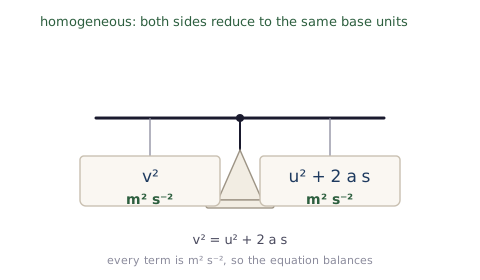
An equation is homogeneous when every term reduces to the same SI base units, so the two sides balance. It is a quick and powerful check, but it cannot catch a wrong pure number: a missing factor of one half passes the test. Homogeneity is therefore necessary for a correct equation, but not sufficient.
Sixty minutes, phase by phase
| Time | Phase | What happens in the room | Resources |
|---|---|---|---|
| 0 to 5 min | Starter | Why can a space mission fail over a unit mix-up? Pose: what makes a measurement meaningful? Learners agree a number needs a unit. | Slide 1 |
| 5 to 20 min | Teach: units | Introduce the base quantities and units; build the newton, joule and pascal from their defining relations in base units. | Slides 2 to 6, fig-base-units, fig-derived-units |
| 20 to 25 min | Teach: prefixes | Present the prefixes pico to tera; model two conversions, keeping the power of ten explicit. | Slide 7, fig-prefixes |
| 25 to 35 min | Teach: homogeneity | Define homogeneity; model checking an equation and finding the base units of a constant as a class. | Slides 8 to 10, fig-homogeneity |
| 35 to 50 min | Activity | Quiz-Quiz-Trade with the unit and prefix cards: quiz a partner, coach, trade, find a new partner. The teacher notes the most-missed cards. | Quiz-Quiz-Trade card set |
| 50 to 60 min | Plenary | Exit ticket, then review the most-missed cards. | Exit ticket slide |
The joule, the pascal, and a homogeneity check
Express the joule and the pascal in SI base units, then check that E = ½ m v² + m g h is homogeneous.
Testing homogeneity, step by step
- write each quantity in the equation in SI base units
- work out the base units of every separate term
- if every term has the same base units, the equation is homogeneous
- to find an unknown unit, rearrange for the unknown and reduce the right side to base units. For F = k x, the spring constant k = F / x = kg m s−2 / m = kg s−2
Quiz-Quiz-Trade
Each learner holds one card with a prompt on the front and the answer on the back. Learners pair up: partner A quizzes partner B and coaches if needed, then they swap roles. Partners trade cards, thank each other, and find a new partner, repeating for about fifteen minutes while the teacher circulates and notes which cards are missed most. A full step-by-step facilitation guide, with the printable card set and a teacher answer key, is provided as the activity in this bundle, so it can be run faithfully, including by a cover teacher.
Why it suits this lesson. Fluency with units underpins the whole course, and it is built by repetition with feedback. Quiz-Quiz-Trade gives every learner many quick rounds of both answering and coaching, so participation is roughly equal and the most-missed cards surface for the plenary.
What to head off, and how
| Trap learners fall into | Teaching move that pre-empts it |
|---|---|
| Treating the kilogram as a prefix problem. | The kilogram is the SI base unit of mass, even though it carries the prefix "kilo". It is not "grams with a kilo on it" for these purposes. |
| Believing a homogeneous equation must be correct. | Homogeneity cannot detect a wrong pure number, such as a missing factor of one half. It is necessary but not sufficient. |
| Moving the digits, not the power of ten, in a prefix conversion. | Keep the power of ten explicit: 1 GW = 109 W. Convert by changing the exponent, then tidy into standard form. |
| Confusing a derived-unit name with its base-unit form. | The newton is a name; its base-unit form is kg m s−2. Build the form from the defining relation every time. |
Support, challenge and the checks
- Support: a base-unit reference strip and a part-worked homogeneity example with one term left blank.
- Challenge: find the base units of the gravitational constant G from F = G m1 m2 / r2, and explain why a homogeneous equation can still be wrong.
- Language: rehearse the frames "the base units of ... are ..." and "this equation is homogeneous because ..." before learners write.
Assessment is formative. Exit ticket question 1: express the volt in SI base units. Exit ticket question 2: is P = F v homogeneous? Justify using base units. Circulating during Quiz-Quiz-Trade gives a quick read on which cards, and which learners, need another pass.
Equipment and resources
- the printable Quiz-Quiz-Trade card set and the worksheet from this bundle
- a base-unit reference strip for support, and the exit ticket from the final slide
- the student topic page Physical quantities and units