Quiz a partner, coach, trade, move on
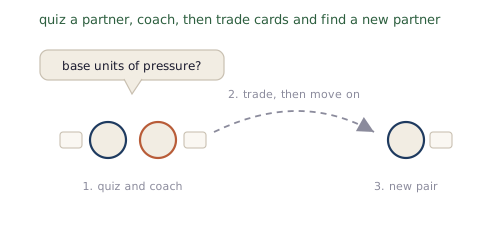
Each learner holds one card with a prompt on the front and the answer on the back. Learners pair up: partner A quizzes partner B and coaches if needed, then they swap roles. Partners trade cards, thank each other, and find a new partner. Because every learner both answers and coaches on every round, participation is roughly equal and no one sits out.
It passes the PIES test:
Partners rely on each other to quiz, coach and check, so each round needs both learners engaged.
Every learner answers each card they are quizzed on and coaches the next partner, so each is on the hook.
Both roles, answering and coaching, happen on every round, so participation is roughly balanced.
Many pairs are active at once, so a large share of the class is talking and recalling at any moment.
Two things to prepare
- Print and cut one card per learner (the deck repeats if the class is larger than the set). Print double sided, or fold, so the answer is on the back.
- Have a base-unit reference strip ready for any learner who needs support while coaching.
About fifteen minutes
Give each learner one card, prompt on the front and answer on the back.
Learners pair up. Partner A quizzes partner B on the card and coaches the answer if needed, then they swap roles.
Partners trade cards, thank each other, and raise a hand to find a new partner.
Repeat for the set time. The teacher circulates and notes which cards are missed most, to review in the plenary.
Sentence frames for the answer
The teacher's role during the activity
Keep the pairs moving and the rounds short. Listen for the common slips, a wrong power of ten or a forgotten s−2, and note the cards that get missed most so they can be reviewed together at the end. The goal is fluent recall through many quick, coached repetitions.
Sixteen cards: front prompt, back answer
Print one set, cut along the rows, and print double sided or fold so the answer is on the back. The deck repeats for larger classes.
When the room does not behave like the plan
A learner is stuck on their own card: that is fine; their partner coaches them, and they will have it by the next trade.
Pairs finish too fast: ask the coach to also state the defining relation, for example "pressure is force over area".
An odd number of learners: form one trio that rotates the quizzer, or join in as a partner.
The room gets loud: use a quiet signal and keep the trades brisk; the noise is mostly on-task recall.
- Support: give weaker recallers the prefix cards first, and a base-unit reference strip to coach from.
- Challenge: add blank cards and have learners write their own derived-unit prompt and answer to add to the deck.